Policy Decoder #001: Korea Broadcast Its Value-Up Roadmap. Where Governance Sat Tells You the Fight Is Over.
Korea broadcast its Value-Up roadmap on 22 August 2025. Where corporate-governance reform sat in that briefing — and what takes effect 23 July 2026 — tells you the legislative fight is over.
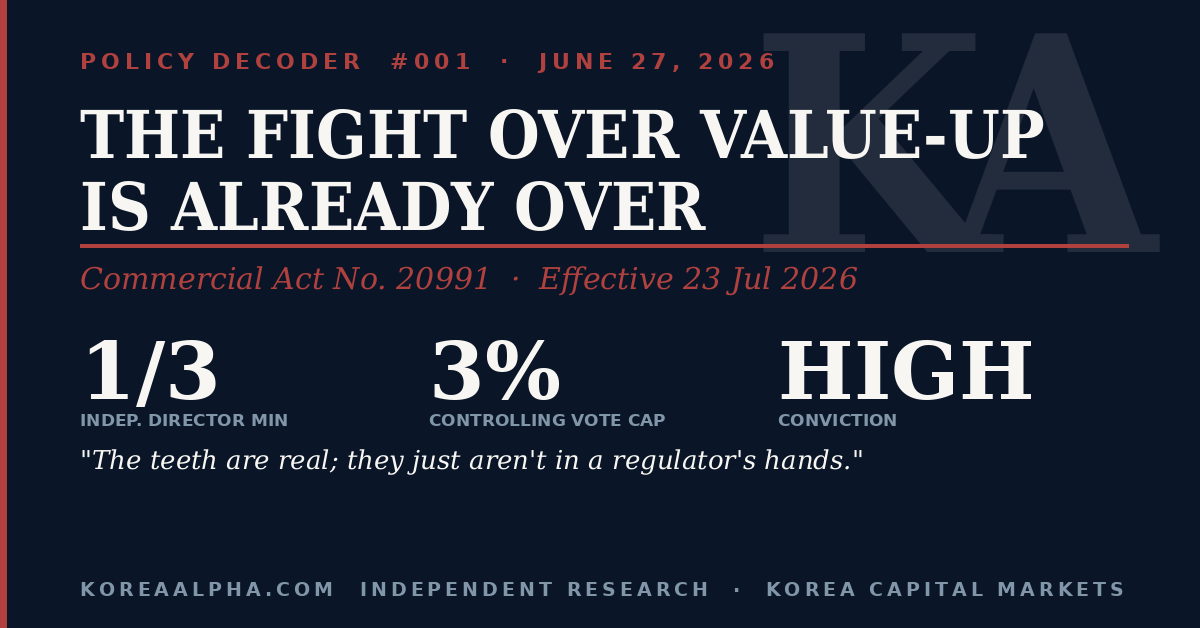
The Signal
The 23 July 2026 enforcement milestone of the corporate-governance reform Korea's government laid out, on a live broadcast, in its "New Government Economic Growth Strategy" of 22 August 2025.
Source: MOEF economic-ministers' meeting briefing, 22 Aug 2025; law.go.kr, Commercial Act Nos. 20991 & 21448.
What Was Announced
On 22 August 2025, the Deputy Prime Minister and Finance Minister chaired a broadcast economic-ministers' meeting and unveiled a growth strategy headlined by AI and "hyper-innovation." Governance reform appeared not at the top, but under the third of four pillars, "fair growth", and framed as settling in the already-amended Commercial Act. The hard dates behind that framing: directors' fiduciary duty to all shareholders, in force since July 2025; the independent-director minimum rising to one-third of the board and a strengthened "3% rule" capping a controlling shareholder's vote in audit-committee elections, effective 23 July 2026; and mandatory cancellation of treasury shares within one year, in force since 6 March 2026, with fines up to KRW 50 million (~$33,000) on individual directors.
What It Actually Signals
The operative provision in the July batch is the 3% rule, not the director re-labelling. By capping the controlling family's vote when audit-committee members are elected, it hands minority and activist shareholders a structural, repeatable lever to seat genuine oversight, the point at which governance pressure stops depending on the policy mood of any given year.
Why a Foreign Investor Should Care
The Korea discount has rested on one suspicion: that controlling families can override minority interests at will. These provisions attack that mechanism through enforceable channels, not disclosure nudges. With foreign ownership near a multi-year high, foreign votes now carry real weight under a capped controlling ballot, the transmission line from governance reform to a narrower PBR gap.
The Tell
Where the reform sat in the broadcast is the signal. It wasn't the headline; it was a "settling-in" task under the third pillar, behind AI. Translation: Seoul no longer treats Value-Up governance as a policy to win, it treats it as infrastructure to install on a fixed clock. And the install method confirms it. The liability is hard law (shareholder suits; director fines), while the Ministry of Justice's compliance guideline is deliberately non-binding. The government has stopped arguing the stick and started wiring it, into the courts and the share register, then stepping back. The teeth are real; they just aren't in a regulator's hands.
Conviction
HIGH that the provisions take effect as dated, promulgated statute, fixed effective dates. The open variable is enforcement intensity in the first proxy cycle, since controlling families had a one-year runway to build defenses.
Watch Next
- First AGM/EGM season after 23 July 2026, whether minority or activist slates actually seat audit-committee members under the capped vote. The receipt.
- The 10 September 2026 wave (Act No. 21044): mandatory cumulative voting and expanded separate election of audit-committee members at large caps.
Research only, not investment advice. KoreaAlpha does not provide personalised recommendations.
[Correction, 2026-08-08] A USD conversion in this post was computed at an incorrect exchange rate. The actual USD/KRW close on 26 June 2026 was 1,537.5. The figure has been recomputed; the KRW figure is unchanged.