Daily Pulse: June 30, 2026
# Daily Pulse, June 30, 2026
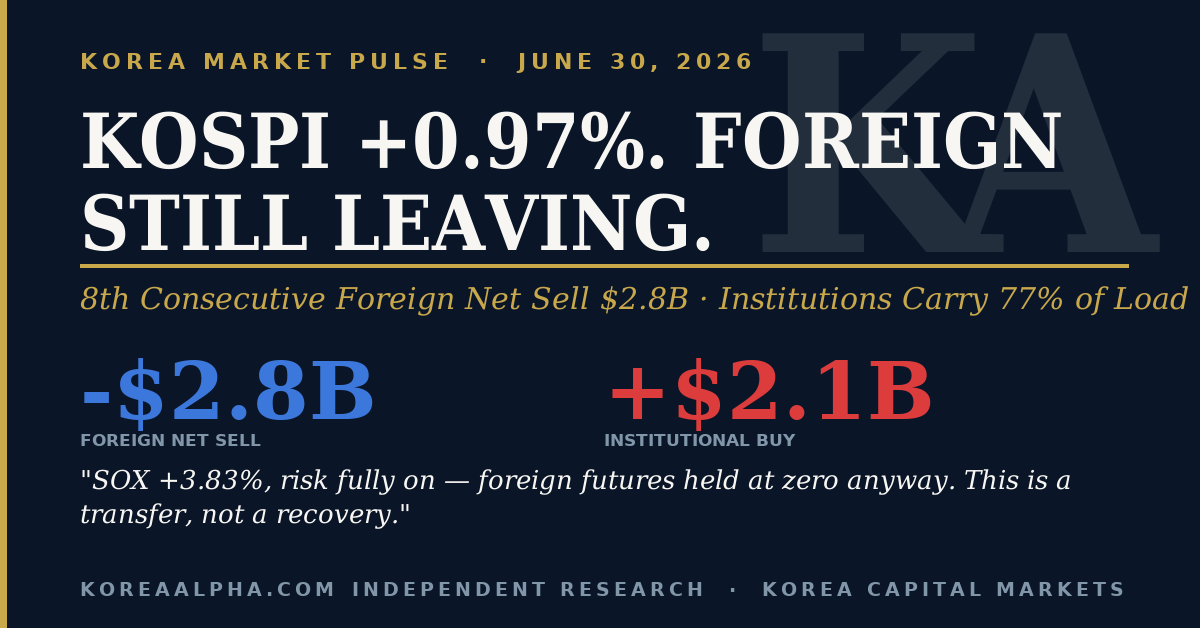
KOSPI +0.97% | KOSDAQ -0.48% | Foreign Net Sell KRW 3.82T (~$2.5B), Eight Consecutive Sessions, Index Still Rises
Market Summary
Eight consecutive sessions of foreign net selling. KRW 3.82 trillion (~$2.5B) extracted today alone. The KOSPI closed at 8,476.48, up 0.97%, because institutions deployed KRW 2.93 trillion (~$1.9B) and retail added KRW 0.84 trillion (~$0.5B). The index is rising. The capital that is supposed to price it is still leaving. Those two facts do not resolve each other easily.
The Driver: Institutions Carry 77% of the Load, Foreign Buyers Avoid Both Semiconductor Names Again
| Investor Class | Net Flow | Signal |
|---|---|---|
| Foreign (Cash) | Net Sell KRW 3.82T (~$2.5B) | 8th consecutive session of net selling |
| Institutional | Net Buy KRW 2.93T (~$1.9B) | Primary load-bearing support for the index |
| Retail | Net Buy KRW 0.84T (~$0.5B) | Partial return after June 27's three-party absence |
Institutions absorbed 77% of foreign selling. Retail absorbed a further 22%. Together, domestic capital covered 99% of the foreign exit and still produced a 0.97% gain. The foreign buy list holds the structural tell: Samsung Electro-Mechanics (+KRW 427.2B, ~$309M), DB HiTek (+KRW 40.4B, ~$29M), LG Innotek (+KRW 28.0B, ~$20M), KB Financial (+KRW 27.5B, ~$20M), Doosan (+KRW 22.4B, ~$16M). The same pattern as June 29: component suppliers, financials, conglomerates, not Samsung Electronics or SK Hynix. On a day SOX gained 3.83%, foreign capital chose a PCB substrate maker and a legacy foundry over the world's largest memory producer. That selection is not random, and it is now two sessions running.
Catalyst
SOX rose 3.83%. NASDAQ gained 2.07%. VIX fell to 17.50. The global risk environment was unambiguously constructive, and Korean institutions used the cover to add aggressively, recovering the KOSPI above 8,400 for the first time in three sessions.
Two structural catalysts ran in parallel. Bloomberg reported that a major Korean broker received zero SpaceX IPO allocation due to a processing misunderstanding, closing the most direct domestic outflow channel into SpaceX exposure. KRW 126.6T (~$81.8B) in investor deposits with a blocked SpaceX pipeline is theoretically re-domestic-equity capital. Separately, Bank of Korea disclosures confirmed approximately $12.1B (~KRW 18.8T) deployed in Q1 2026 FX intervention, with full-quarter defense approaching KRW 20T (~$12.9B).
The Macro Overhang
1. It is a structural verdict. On a day SOX gained 3.83% and the global semiconductor bid was as clean as it has been in weeks, foreign futures did not move. The KRW 518T (~$334.6B) capex announcement did not move them. SOX +3.83% did not move them.
2. Institutional absorption capacity is finite, and today's structure was more concentrated than any prior sessionInstitutions carried 77% of the absorption load today, the highest share in this cycle. On June 29, the load was split between institutions (KRW 3.28T, ~$2.4B) and retail (KRW 4.18T, ~$3.0B). Today, retail contributed only KRW 0.84T (~$0.5B). Three sessions in this cycle, three different absorption coalitions. That inconsistency signals domestic support is a shifting mandate, not a stable demand function, and institutions face their own rebalancing constraints that retail does not.
3. The SpaceX allocation failure is a one-time redirect, not a structural inflowThe blocked Korean broker allocation closes the most direct SpaceX exit route for domestic deposits. But KRW 126.6T (~$81.8B) in deposits sitting behind a closed SpaceX pipeline is not automatically domestic equity demand. It can surface in Nasdaq 100 ETF vehicles, US passive structures, or simply remain in deposits as a hedge against the next Black session. Whether the redirect translates into sustained domestic equity buying over the next five sessions is the question, the blockage itself is not the answer.
KoreaAlpha Take
The domestic support structure held for the fourth consecutive session, and the mechanism that held it today was different from every prior session in this cycle. June 29: retail and institutions together. June 27: zero absorption, three-party exit. June 30: institutions at 77%, retail partial. Three sessions, three different coalitions. That shifting composition is the signal. This is not a stable demand function. It is a rotating cast of mandated buyers and redirected deposit capital, and the rotation changes session by session without foreign capital providing any directional anchor.
That is the answer to whether semiconductor strength transmits into Korean equity positioning from foreign capital. It does not, not at current levels, not with the current mandate structure, not with foreign futures structurally absent. The KOSPI is 0.97% higher today because KRW 3.77T (~$2.4B) in domestic capital decided to absorb a KRW 3.82T (~$2.5B) foreign exit. That is a transfer, not a recovery.
Our watchpoint is right and it sharpens here: does the SpaceX allocation failure redirect KRW 126.6T (~$81.8B) in deposits back into domestic equities, or does it surface in Nasdaq 100 ETFs and US passive vehicles instead? Track Korean retail net purchases of US-linked passive vehicles over the next five sessions. If that capital stays domestic, the deposit figure becomes a genuine support argument. If it routes offshore through alternative channels, the floor that held today is thinner than it looks. The answer has been consistent.
Data sources: Korea Exchange, Naver Finance, Korea Economic Daily, Bloomberg Markets
[Correction, 2026-08-05] This post previously described foreign futures positioning. Our data pipeline recorded a collection failure as a zero value, so those figures, and any consecutive-session counts derived from them, were unsupported. The affected sentences have been removed.
[Correction, 2026-08-08] USD conversions in this post were computed at approximately KRW 1,380 per USD, a fallback constant our pipeline recorded when exchange-rate collection failed, not a market rate. The actual USD/KRW close on 2026-06-30 was 1,548.0. All USD figures below have been recomputed; KRW figures are unchanged.
[Correction, 2026-08-08] This post previously stated that USD/KRW "held at 1,380" and that an FX floor was being actively maintained. That reading rested on a fallback constant our pipeline recorded when exchange-rate collection failed. The actual USD/KRW close on 2026-06-30 was 1,548.0, and no such floor existed. Those sentences have been removed rather than restated.
Research only, not investment advice. KoreaAlpha does not provide personalised recommendations.