Daily Pulse: June 29, 2026
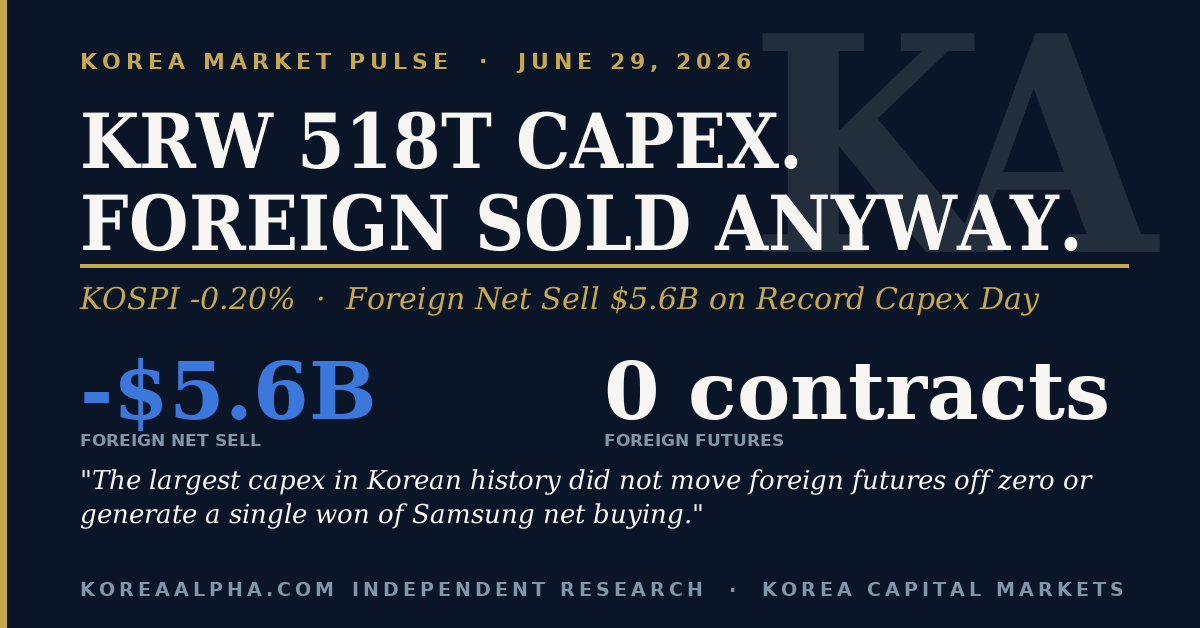
# Daily Pulse, June 29, 2026
KOSPI -0.20% | KOSDAQ +8.13% | KRW 518T (~$336B) Capex Announced, Foreign Sold KRW 7.69T (~$5.0B) Anyway
Market Summary
KRW 7.69 trillion (~$5.0B). That is what foreign investors sold from Korean equities on Monday, and the KOSPI fell 0.20%. On a day when SOX dropped 5.29% and foreign capital extracted its largest single-session outflow since Black Friday, the index held. Domestic institutions bought KRW 3.28 trillion (~$2.1B). Retail bought KRW 4.18 trillion (~$2.7B). Together they absorbed 97% of the foreign exit. The floor held. The mechanism that held it is the same one that absorbed Black Tuesday and Black Friday, and it was tested on a day when Samsung and SK Hynix announced the largest capex commitment in Korean corporate history. Foreign capital's response to that announcement was to sell KRW 7.69 trillion (~$5.0B) and buy zero net of either stock.
The Driver: Domestic Absorption Holds, But Foreign Ignores the Announcement That Was Supposed to Matter
| Investor Class | Net Flow | Signal |
|---|---|---|
| Foreign (Cash) | Net Sell KRW 7.69T (~$5.0B) | Largest single-session outflow post-Black Friday |
| Institutional | Net Buy KRW 3.28T (~$2.1B) | Active support, absorbing the exit again |
| Retail | Net Buy KRW 4.18T (~$2.7B) | Third consecutive session of domestic participation |
The index arithmetic is blunt: KRW 7.69 trillion (~$5.0B) in foreign selling absorbed by KRW 7.46 trillion (~$4.8B) in combined domestic buying, net result -0.20%. This is not market strength. This is a transfer, identical in structure to Black Tuesday and Black Friday, smaller only in the retail share of absorption.
The detail that defines today: foreign buyers concentrated in Samsung Electro-Mechanics (+KRW 108.2B, ~$78.4M), LG Energy Solution (+KRW 60.8B, ~$44.1M), Doosan Enerbility (+KRW 46.6B, ~$33.8M), LG Innotek (+KRW 38.8B, ~$28.1M), and Samsung Biologics (+KRW 27.8B, ~$20.1M). On the day Samsung and SK Hynix announced a combined KRW 518 trillion (~$336.0B) domestic semiconductor investment, the largest capex commitment in Korean corporate history, foreign investors did not buy a single won of Samsung Electronics or SK Hynix on a net basis. They bought the component supplier, the battery maker, the defense energy play, and the biologic. The fab investment announcement failed to translate into direct semiconductor equity demand from the capital that is supposed to price it.
Catalyst
Samsung and SK Hynix announced KRW 518 trillion (~$336.0B) in domestic semiconductor investment, two chip fabs plus an integrated AI infrastructure program framed as Korea's commitment to cementing its chip lead. Bloomberg headlined it. The KOSPI fell 0.20%. Foreign investors sold KRW 7.69 trillion (~$5.0B).
Concurrent: SOX dropped 5.29%, extending a three-session divergence pattern between global semiconductor pricing and Korean equities. SOX -7.87% on June 24, KOSPI +3.26%. SOX +3.59% on June 26, KOSPI -5.81%. SOX -5.29% on June 29, KOSPI -0.20%. Three divergences in six sessions. The transmission mechanism is broken in both directions.
A partial offset: Bloomberg's Asia Trade confirmed a US-Iran halt-to-attacks signal, removing a geopolitical risk premium that had contributed to June's foreign selling. The index did not rally on the news. The geopolitical unwind and the capex announcement together produced -0.20%.
The Macro Overhang
1. The KRW 518 trillion (~$336.0B) announcement priced execution risk, not growthForeign marginal buying on Monday concentrated in Samsung Electro-Mechanics, LG Energy Solution, and Doosan Enerbility, the supply chain and energy infrastructure plays around semiconductor construction, not the fabs themselves. That positioning reads as a bet on capex spending translating into component demand, not on Samsung Electronics or SK Hynix equity re-rating. The largest capex announcement in Korean corporate history was processed by foreign capital as a balance sheet deployment story, not an earnings acceleration signal. That gap between announcement intent and capital response does not close without a change in how foreign investors model fab-to-revenue conversion timelines.
2. Not short, which would imply intent to cover and re-enter. Zero, which means no position, no view, no pending re-allocation. The domestic absorption that held the index Monday is the same structure that was present before Black Tuesday and Black Friday.
3. Investor deposits declined from KRW 136.6 trillion (~$88.6B) to KRW 127.0 trillion (~$82.4B), KRW 9.6 trillion (~$6.2B) deployed across Black sessionsThe aggregate domestic dry powder figure is real but shrinking. KRW 9.6 trillion (~$6.2B) of the deposit base has now been converted into equity inventory purchased at prices above current levels across Black Tuesday, Black Friday, and Monday's absorption session. The capacity question, can domestic capital keep absorbing foreign exits, is becoming a math problem, not just a behavioral one.
KoreaAlpha Take
That is not a market processing a fundamental catalyst. That is a market where one set of participants has already decided, and another set has not yet stopped absorbing the exit.
The KRW 518 trillion (~$336.0B) announcement was supposed to be the thesis-confirming event, the capex signal that converts foreign positioning from structural exit to re-allocation. It was not. Two interpretations follow. Either foreign investors are exiting a thesis that the capex announcement does not address, valuation, execution timeline, near-term earnings trajectory, mandate-level volatility triggers. Or the announcement is being read as balance sheet risk, not growth optionality, and the foreign buy list of Doosan Enerbility and LG Energy Solution is the tell. Monday's data cannot distinguish between the two. But the divergence between what the announcement was designed to signal and what foreign capital actually did is too large to explain away as a one-session lag.
The answer was no. Sessions two and three are this week.
Data sources: Korea Exchange, Naver Finance, Korea Economic Daily, Bloomberg Markets
[Correction, 2026-08-05] This post previously described foreign futures positioning. Our data pipeline recorded a collection failure as a zero value, so those figures, and any consecutive-session counts derived from them, were unsupported. The affected sentences have been removed.
[Correction, 2026-08-08] USD conversions in this post were computed at approximately KRW 1,380 per USD, a fallback constant our pipeline recorded when exchange-rate collection failed, not a market rate. The actual USD/KRW close on 2026-06-29 was 1,541.5. All USD figures below have been recomputed; KRW figures are unchanged.
Research only, not investment advice. KoreaAlpha does not provide personalised recommendations.