Daily Pulse: June 26, 2026
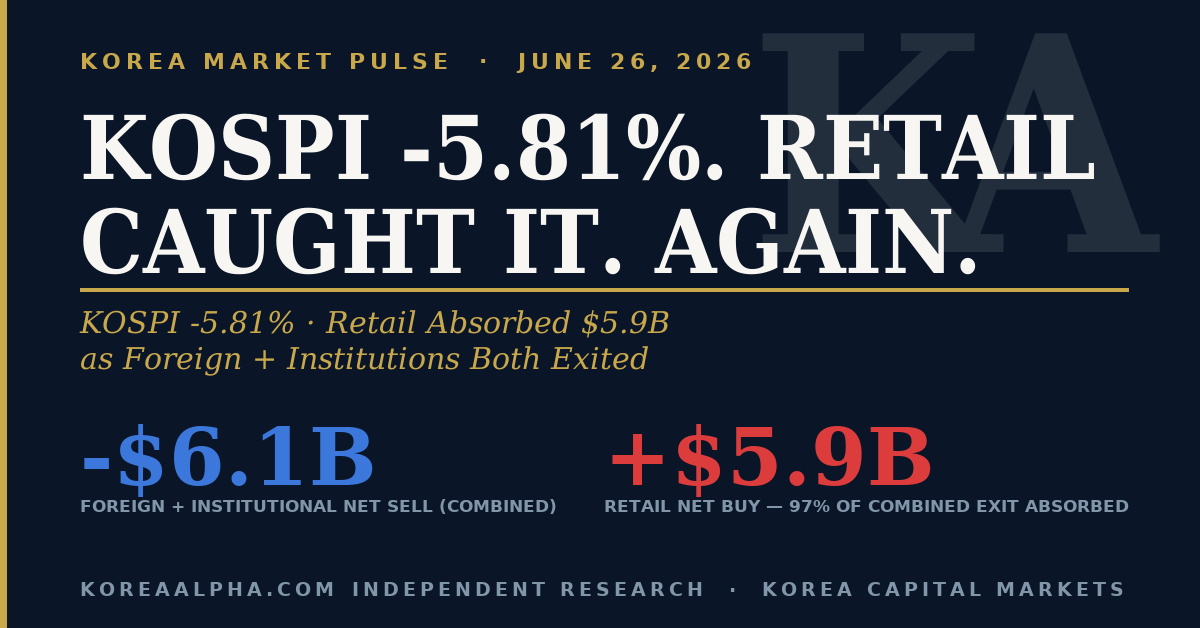
# Daily Pulse, June 26, 2026
KOSPI -5.81% | KOSDAQ -4.10% | KRW 8.43T (~$5.5B), Smart Money Sold. Retail Caught It. Again.
The Number That Matters
KRW 8.43T (~$5.5B). That is the combined foreign and institutional net sell on Friday, and retail absorbed KRW 8.19T (~$5.3B) of it in a single session. The KOSPI fell 519 points to 8,411.21. The domestic press called it Black Friday. The arithmetic is more precise than that: this is the second time in three sessions that Korean retail has caught every share that smart money threw. Black Tuesday was KRW 8.59T (~$5.6B). Black Friday was KRW 8.19T (~$5.3B). The pattern is not a coincidence. It is a structure. And structures have limits.
Flow Structure: The Transfer, Repeated
| Investor Class | Net Flow | Signal |
|---|---|---|
| Foreign (Cash) | Net Sell KRW 4.65T (~$3.0B) | Fifth consecutive session of heavy outflow |
| Institutional | Net Sell KRW 3.78T (~$2.5B) | Simultaneous exit with foreign, no domestic backstop |
| Retail | Net Buy KRW 8.19T (~$5.3B) | Second massive risk absorption in three sessions |
Foreign investors sold KRW 4.65T (~$3.0B). Institutions sold KRW 3.78T (~$2.5B). Together: KRW 8.43T (~$5.5B) of combined exit pressure. Retail absorbed KRW 8.19T (~$5.3B), covering 97% of the combined exit. The index fell 5.81% anyway.
Not short. Not long. Absent. Foreign capital is not trading Korea, it is leaving Korea. The distinction is not semantic. A short position implies intent to re-enter. That is not a bear trade. That is a closed file.
Foreign buyers still active on the cash side concentrated in Samsung Electro-Mechanics (+KRW 120.5B, ~$87.3M), HD Hyundai Heavy Industries (+KRW 65.8B, ~$47.7M), and LG Electronics (+KRW 44.8B, ~$32.5M). For the third consecutive session, the marginal foreign buyer avoided Samsung Electronics and SK Hynix entirely. Non-semiconductor names only.
Why the Market Moved, Three Catalysts
1. Global chip selloff triggered a second circuit-breaker event this week
Bloomberg headlined it as a "chip wreck." A market that triggers two circuit-breaker events within five sessions is not experiencing volatility. It is experiencing a structural dislocation. The circuit breaker Bloomberg reported was intraday, but the KOSPI's -5.81% close came after trading was partially halted and then resumed into continued selling. The critical detail: SOX closed +3.59% on Friday. Korean equities fell 5.81% on a session when the global semiconductor index rose. The divergence is no longer a one-day anomaly. It is a pattern.
2. Institutional exit removed the domestic backstop that built Wednesday and Thursday's recovery
Wednesday's +3.26% and Thursday's +5.42% were built on institutional buying absorbing foreign selling. On Friday, institutions joined the exit, KRW 3.78T (~$2.5B) in net selling alongside foreign's KRW 4.65T (~$3.0B). The mechanism that had prevented a full retail risk transfer on recovery days was gone. When both smart-money participants exit simultaneously, the only buyer left is retail. Retail bought KRW 8.19T (~$5.3B).
3. KB Securities KRW 1T (~$650M) rights offering, capital raise at distressed prices
KB Securities launched a KRW 1T (~$650M) rights offering on Friday, framed as a commitment to productive finance. The timing reads differently to foreign investors: a major domestic financial institution accessing equity markets on the second largest single-session decline of the 2026 cycle signals that balance sheet repair, not market stability, is the priority. Rights offerings during panic sessions are not bullish catalysts.
The Macro Overhang
Three risks specific to this week's market structure:
1. Retail's two-session inventory is the next structural overhangKorean retail has absorbed KRW 16.78T (~$10.9B) across Black Tuesday and Black Friday. That capital is no longer dry powder. It is equity inventory purchased at prices 5 to 10% above current levels. When the next selling session arrives, the question is not whether retail has KRW 136.6T (~$88.8B) in deposits. The question is whether the investors who deployed into two consecutive panic sessions have the appetite, and the margin, to deploy a third time.
2. KOSPI-SOX divergence is now a confirmed pattern, not an anomalySOX rose 3.59% on Friday. The KOSPI fell 5.81%. Wednesday's divergence (SOX -7.87%, KOSPI +3.26%) and Friday's divergence (SOX +3.59%, KOSPI -5.81%) move in opposite directions but share the same signal: Korean equities are no longer tracking their primary global driver. A market that cannot rally when semiconductors rise and cannot hold when semiconductors fall has lost its transmission mechanism. That breakdown does not resolve without a catalyst to restore it.
3. Two circuit breakers in five sessions, the threshold that triggers mandate reviewsGlobal EM fund mandates typically include volatility triggers that prompt automatic reviews of country exposure. Two circuit-breaker events in a single week places Korea on those review lists whether or not the fundamental thesis has changed. The next round of foreign selling may not be driven by Korea-specific catalysts at all, it may be driven by risk committees in London and New York responding to volatility metrics.
KoreaAlpha Take
Two Black sessions in three trading days. The same transfer mechanism. The same non-semiconductor foreign buy list. This is not volatility. This is a repeating structure, and repeating structures tell you who is in control of price discovery.
That structural question closes permanently here. The foreign re-allocation question that began on June 12 with KRW 2.0T (~$1.3B) in net buying has its final answer: that single session was not the beginning of anything. It was the last positioning adjustment before an accelerating exit. Since June 12, foreign investors have sold every session with increasing velocity, culminating in two circuit-breaker events and KRW 8.43T (~$5.5B) in combined selling on Friday alone. The re-allocation never came. The exit did.
The question that replaces it is structural: retail has absorbed KRW 16.78T (~$10.9B) across two panic sessions. The KRW 136.6T (~$88.8B) in investor deposits is real, but a meaningful portion of it now sits in equity inventory purchased at prices above current levels. That inventory does not disappear. It becomes the overhang that suppresses every recovery rally when the next round of selling arrives, because the first instinct of an investor who caught two falling knives is not to catch a third, it is to sell the bounce.
The unresolved question is the one we raised this morning: if retail absorbed two rounds of KRW 8T (~$5.2B)-plus selling, can it absorb a third? The KRW 136.6T (~$88.8B) deposit figure answers the capacity question. It does not answer the willingness question, and willingness, after two Black sessions in a week, is the variable that matters.
One watchpoint: whether retail net buying in the next heavy-selling session holds above KRW 5T (~$3.3B). That threshold separates a functioning domestic support structure from one that has reached its behavioral limit.
Data sources: Korea Exchange, Naver Finance, Korea Economic Daily, Bloomberg Markets
[Correction, 2026-08-05] This post previously described foreign futures positioning. Our data pipeline recorded a collection failure as a zero value, so those figures, and any consecutive-session counts derived from them, were unsupported. The affected sentences have been removed.
[Correction, 2026-08-08] USD conversions in this post were computed at approximately KRW 1,380 per USD, a fallback constant our pipeline recorded when exchange-rate collection failed, not a market rate. The actual USD/KRW close on 2026-06-26 was 1,537.5. All USD figures below have been recomputed; KRW figures are unchanged.
Research only, not investment advice. KoreaAlpha does not provide personalised recommendations.