Daily Pulse: June 25, 2026
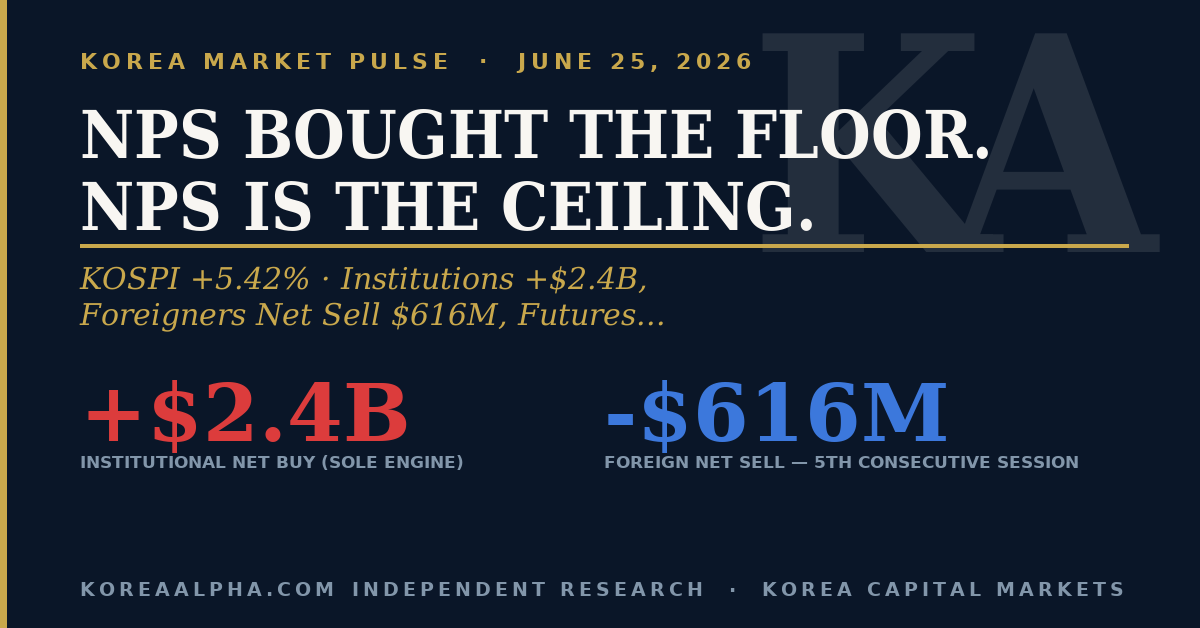
KOSPI +5.42% | KOSDAQ -2.36% | NPS KRW 74T (~$47.9B), The Institution Bought. The Floor May Also Be the Ceiling.
The Number That Matters
KRW 3.30T (~$2.1B). That is how much institutional capital, led by pension and domestic fund flows, bought into Thursday's KOSPI surge, lifting the index 459 points to 8,930.30. The headline reads like a recovery. The structure beneath it does not. The same institutional force that absorbed the Black Tuesday collapse is now the only force driving the recovery, and it operates under a mandate that automatically sells when the KOSPI crosses 9,000. Thursday's rally was bought by the one participant with a built-in exit trigger 70 points above the close.
Flow Structure: Institutions Run the Table, Alone
| Investor Class | Net Flow | Signal |
|---|---|---|
| Foreign (Cash) | Net Sell KRW 850B (~$550M) | Fifth consecutive session of net selling |
| Institutional | Net Buy KRW 3.30T (~$2.1B) | Sole engine of the +5.42% move |
| Retail | Net Sell KRW 2.42T (~$1.6B) | Retail exits into the institutional bid |
The flow structure on Thursday inverts everything that defined the Black Tuesday aftermath. On June 23, retail bought KRW 8.59T (~$5.6B) while institutions sold. On June 25, institutions bought KRW 3.30T (~$2.1B) while retail sold KRW 2.42T (~$1.6B). The risk transfer has reversed direction. Retail, holding leveraged positions accumulated during the collapse, is now distributing into the institutional bid at prices 727 points above Black Tuesday's close.
The detail that demands attention: KRW 110.7B (~$71.7M) in forced margin liquidations were triggered on Thursday despite the rally. The domestic press confirmed it, KRW 110.7B in retail positions forcibly closed on a +5.42% session. The leverage accumulated on the way down is being unwound on the way up, and the unwinding has not finished.
Foreign buyers concentrated in Samsung Electronics preferred shares (+KRW 224B, ~$162M), Daeduck Electronics (+KRW 40.1B, ~$29.1M), Kia (+KRW 23.6B, ~$17.1M), Hyundai Mobis (+KRW 22.7B, ~$16.5M), and Korean Air (+KRW 22.1B, ~$16.0M). Non-semiconductor, diversified, opportunistic. Not a semiconductor re-allocation. A valuation trade in names that fell collaterally.
Why the Market Moved, Three Catalysts
1. Micron earnings, the semiconductor fear trade unwound overnight
The domestic headline said it directly: "We were counting on you, Micron, semiconductor fears cleared, KOSPI surged 5.4%." Micron's results cleared the overhang that had compressed Korean semiconductor valuations since Black Tuesday. When the global benchmark memory name delivers, the re-rating of SK Hynix and Samsung Electronics is mechanical, and Thursday's institutional buyers executed that re-rating at scale. Bloomberg confirmed the directional read: SK Hynix ADR analysis pointed to 30% upside as the Micron gap narrows. That thesis landed in institutional models simultaneously with Thursday's open.
2. Post-Black Tuesday institutional rebalancing, NPS and domestic funds executing mandated dip-buying
The KRW 3.30T (~$2.1B) institutional net buy is not discretionary conviction. It is the mechanical consequence of a market that fell 9.99% on June 23 triggering rebalancing mandates across pension and domestic fund portfolios. National Pension Service and domestic equity funds with target weight ranges buy automatically when the KOSPI drops outside their band. Thursday's 459-point surge was the arithmetic result of that mandate executing, not a forward-looking judgment about Korean equity fundamentals.
3. KOSDAQ decoupling, the semiconductor/battery split becomes structural
Thursday's KOSDAQ -2.36% against KOSPI +5.42% is not noise. It is the market pricing two distinct economies simultaneously: the semiconductor recovery trade concentrated in KOSPI heavyweights, and the secondary battery collapse concentrated in KOSDAQ growth names. The domestic press framed it precisely: "KOSPI smiled on semiconductors; KOSDAQ wept over secondary batteries." The index that was once Korea's growth engine is now the loss ledger for retail's battery bet. KRW 136.8T (~$88.5B) in investor deposits is watching, and has not moved into either market.
The Macro Overhang
Three risks specific to this week's market structure:
1.NPS KRW 74T (~$47.9B) sell mandate activates 70 points higherThe National Pension Service's mechanical sell trigger at KOSPI 9,000 was confirmed by domestic press on Thursday. The institution that just provided KRW 3.30T (~$2.1B) in net buying becomes a structural seller at 8,930 + 70. Foreign investors are absent. Retail is already selling. When the mandate flips, the only active buyer in Thursday's session becomes the largest seller in Friday's.
2.KRW 110.7B (~$71.7M) in forced retail liquidations, and the margin book is not clearedForced closures on a +5.42% session confirm that the leverage accumulated during Black Tuesday's panic buying has not been fully unwound. The margin book that retail built absorbing KRW 8.59T (~$5.6B) on June 23 is still generating forced sells on the way up. If the KOSPI stalls near 9,000, the margin unwind and the NPS sell mandate arrive simultaneously.
3. Bloomberg called 30% upside in SK Hynix. The KOSPI surged 5.42%. The semiconductor catalyst that institutional buyers used to justify KRW 3.30T (~$2.1B) in net buying did not produce a single net futures contract from foreign capital. Either foreign investors do not believe the re-rating, or they have repositioned away from Korea entirely and are not yet re-entering regardless of the catalyst.
KoreaAlpha Take
A market that rises 5.42% on institutional mandate buying while every other participant sells is not recovering. It is being managed, and managed markets have ceilings built into the management framework.
That structural question closes permanently here. There is no re-allocation. There is selective opportunism by marginal foreign capital, and the primary foreign positioning story for Korean equities in 2026 is exit, not entry.
The structural thesis, the NPS ceiling, opens now. The KRW 74T (~$47.9B) NPS overhang is the most consequential variable in Korean equities for the next two weeks. If the institution that bought KRW 3.30T (~$2.1B) on Thursday activates its sell mandate at 9,000, the rally that retail sold into on the way up becomes the distribution event that caps the recovery. The retail margin book, still unwinding, KRW 110.7B (~$71.7M) force-closed on Thursday alone, faces that ceiling simultaneously.
Micron cleared the semiconductor fear. NPS creates the structural fear that replaces it.
The trade is simple: watch whether foreign futures turn net positive before the KOSPI crosses 9,000. If they do not, the NPS sell trigger fires into a market where the only active buyer has a mandate, not a thesis, and 9,000 becomes the level everyone can see coming and no one can stop.
Data sources: Korea Exchange, Naver Finance, Korea Economic Daily, Bloomberg Markets
Nothing here is investment advice. Research for informational purposes only.
[Correction, 2026-08-05] This post previously described foreign futures positioning. Our data pipeline recorded a collection failure as a zero value, so those figures, and any consecutive-session counts derived from them, were unsupported. The affected sentences have been removed.
[Correction, 2026-08-08] USD conversions in this post were computed at approximately KRW 1,380 per USD, a fallback constant our pipeline recorded when exchange-rate collection failed, not a market rate. The actual USD/KRW close on 2026-06-25 was 1,545.0. All USD figures below have been recomputed; KRW figures are unchanged.
Research only, not investment advice. KoreaAlpha does not provide personalised recommendations.