Daily Pulse: June 24, 2026
# Daily Pulse, June 24, 2026
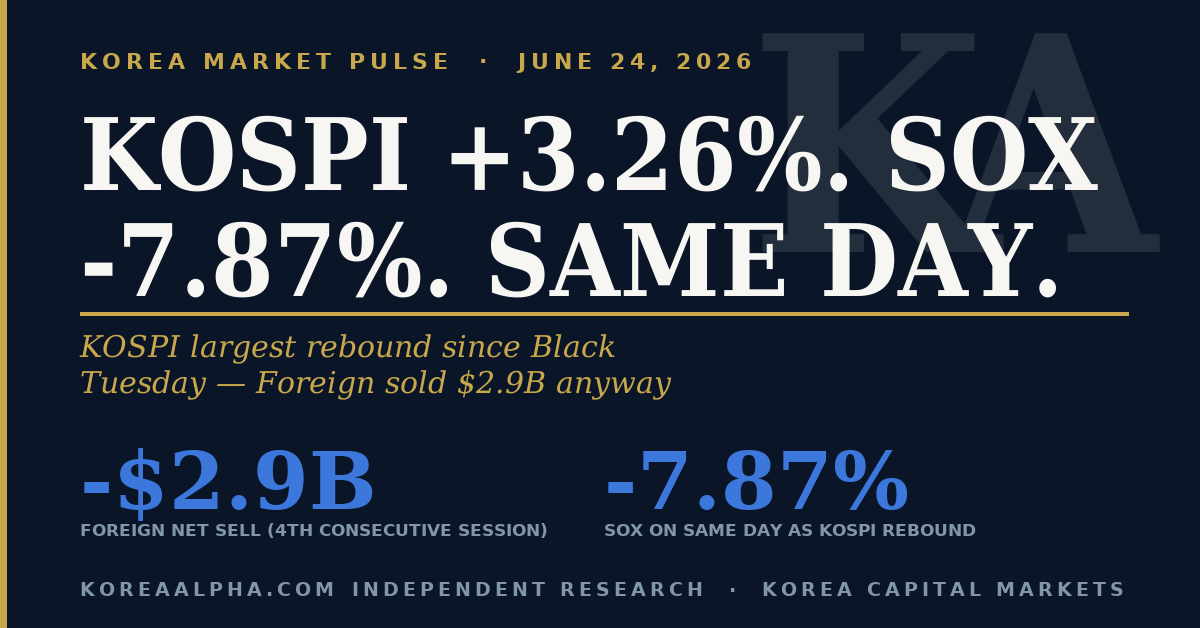
KOSPI +3.26% | KOSDAQ +2.00% | SOX -7.87%, The KOSPI Rallied While Its Catalyst Collapsed
The Number That Matters
The Philadelphia Semiconductor Index fell 7.87% on Tuesday. The KOSPI rose 3.26%. That divergence, 267 points recovered to 8,471.02, the largest single-session rebound since Black Tuesday, is the only number that matters today, because it breaks every framework that has governed the Korean market for the past six weeks. When SOX falls, Korean semiconductors fall. That has been the rule. On June 24, the rule did not apply. Either Korea is decoupling from its primary global driver, or the rebound is an artifact of post-panic positioning that has nothing to do with fundamentals. One of those explanations is bullish. The other is not.
Flow Structure: Domestic Capital Caught the Falling Knife Again
| Investor Class | Net Flow | Signal |
|---|---|---|
| Foreign (Cash) | Net Sell KRW 4.05T (~$2.6B) | 4th consecutive session of selling, half-year rebalancing in progress |
| Institutional | Net Buy KRW 2.05T (~$1.3B) | Institutions step in to support, absorbing foreign outflow |
| Retail | Net Buy KRW 1.89T (~$1.2B) | Retail buying the bounce, KRW 132T deposit base provides firepower |
| Investor Class | Net Flow | Signal |
|---|---|---|
| Foreign (Cash) | Net Sell KRW 4.05T (~$2.6B) | Fourth consecutive session of heavy outflow |
| Institutional | Net Buy KRW 2.05T (~$1.3B) | Defensive bid, absorbed partial foreign exit |
| Retail | Net Buy KRW 1.89T (~$1.2B) | Second consecutive session of retail support |
Foreign investors sold KRW 4.05T (~$2.6B), the fourth consecutive session of net selling following Black Tuesday's KRW 4.24T (~$2.7B) exit. Every share foreign capital threw, domestic capital caught. Institutional buyers provided KRW 2.05T (~$1.3B) in support; retail added another KRW 1.89T (~$1.2B). Combined, they absorbed more than 97% of the foreign exit. The index rose 3.26%.
Again. On a day when the KOSPI posted its largest rebound in weeks, foreign investors expressed precisely no directional conviction. They did not short the rally. They did not join it. They are not trading Korea. They are exiting it.
Foreign buyers on the cash side concentrated in LS (+KRW 46.5B, ~$33.7M), LG Innotek (+KRW 35.7B, ~$25.9M), and LG Electronics (+KRW 29.2B, ~$21.2M), non-semiconductor names. Samsung Electronics and SK Hynix, the two stocks that have mechanically driven every prior rally, were not the vehicle for today's move.
Why the Market Moved, Three Catalysts
1. Black Tuesday technical rebound, post-panic positioning, not new conviction
A -9.99% single-session collapse creates its own reversal mechanics. Margin-call selling exhausts itself. Levered short positions book profits. Domestic institutions with mandated rebalancing triggers buy the dip. Wednesday's +3.26% is textbook post-crash mean reversion, which is not the same thing as a new bull case. Bloomberg confirmed the mechanism: leveraged Korea ETFs sold an estimated $5B (~KRW 8.3T) of shares during the rout. When that forced selling stops, the index bounces.
2. Foreign rotation into non-semiconductor Korean names, an anomaly worth watching
The largest foreign net buys on Wednesday were LS, LG Innotek, and LG Electronics, not Samsung, not SK Hynix. Foreign buyers still active in Korea are not expressing semiconductor conviction. They are picking up industrial and components names that fell collaterally in the Black Tuesday collapse. This is opportunistic cherry-picking, not a re-allocation thesis. Samsung Biologics (+KRW 25.6B, ~$18.6M) and Celltrion (+KRW 25.1B, ~$18.2M) in the foreign buy list reinforce the same read: the marginal foreign buyer is sector-agnostic, not a semiconductor re-allocator.
3. SOX -7.87% on the same day, the impossible divergence
The KOSPI and SOX moving in opposite directions by more than 11 percentage points in a single session is not a normal market event. The domestic press framed Wednesday as a recovery from Black Tuesday. The global semiconductor market priced the opposite narrative simultaneously. SOX -7.87% alongside NASDAQ -2.21% and S&P 500 -1.44% means global risk-off was the dominant signal everywhere except Korea. That contradiction does not resolve itself. It gets answered by Thursday's open.
The Macro Overhang
Three risks specific to this week's market structure:
1. SOX -7.87% opens Thursday with the wrong backdropWednesday's +3.26% KOSPI recovery was built entirely on domestic capital absorption. Thursday opens into a global session where the semiconductor index that drove every Korean equity rally for 18 months just fell 7.87%. The domestic bid that caught KRW 3.94T (~$2.6B) in combined institutional and retail buying on Wednesday faces its first stress test at the open.
2. Foreign exit velocity unresolved at four consecutive sessionsKRW 4.05T (~$2.6B) on Wednesday follows Black Tuesday's KRW 4.24T (~$2.7B). The exit is not decelerating. The question of whether this is residual position liquidation completing, or steady-state withdrawal by capital that has permanently repositioned away from Korea, determines whether 8,471 is a recovery base or a distribution level. USD/KRW at 1,541.8, the highest since the financial crisis per domestic press, compounds every foreign holder's USD-return calculation.
3. KOSDAQ's structural deterioration is acceleratingWednesday's +2.00% KOSDAQ gain masked the headline from domestic press: KOSDAQ's share of total Korean market cap has halved from 12% to 6% since its 30th anniversary. The index that once represented Korea's growth economy is now structurally irrelevant. Retail predicate cash of KRW 132.2T (~$85.6B) sitting in investor deposits has not rotated into KOSDAQ names, it has parked. If that capital does not convert to buying, the firepower argument for a sustained domestic bid is theoretical.
Why Did the Market Crash Yesterday, And Bounce Today?
Yesterday's -9.99% was not a fundamental sell-off. Three structural forces converged simultaneously.
1. Foreign Half-Year Rebalancing (Mechanical, Not Discretionary)
Foreign investors have accumulated 100%+ returns on Korean equities in 2026. At half-year close (June 30), position limits force systematic trimming regardless of outlook. This is not a judgment on Korea, it is a calendar event. The selling is mechanical. It has a hard deadline.
2. Pension Fund Capacity Exhausted
Korea's national pension fund (NPS), the natural buyer when foreigners sell, is already running ~30% domestic equity allocation against a ~20% target. It has no room to absorb. Without the institutional backstop, foreign selling hits thinner order books and moves prices further than the volume alone would suggest.
3. Leveraged ETF Amplification
Bloomberg estimated single-stock leveraged ETFs alone liquidated $6 billion during Tuesday's rout. As the index fell, 2x and 3x levered products triggered forced selling at accelerating rates, turning a 3-4% institutional move into a -9.99% session. This is the structural reason KOSPI's daily volatility has expanded from ~1% to ~4% in recent months.
The Fundamentals Haven't Moved
While the flow structure broke down, the underlying business case for Korean equities remains intact, and in Samsung's case, just got stronger.
Samsung Electronics and SK Hynix trade at 6-7x forward PE, among the cheapest large-cap semiconductor names globally. TSMC reported May revenue +30% YoY, confirming hyperscaler demand is intact. The earnings outlook has not been revised down.
Today Samsung confirmed plans to buy back KRW 90 trillion (~$58B) in shares, approximately 5% of outstanding shares, to fund employee performance bonuses paid in stock. The stock surged 7% intraday on the announcement. This is not a rumor; it is a filed disclosure.
Investor deposits stand at KRW 132.2 trillion (~$86B), domestic retail has the firepower and the appetite. Today's +KRW 1.89 trillion (~$1.2B) net buying confirms the bid. The question is whether foreign rebalancing exhausts before retail conviction does.
Half-year rebalancing ends June 30. The mechanical selling has a timer. July 1 is the first clean read on whether this was a flow disruption or a re-rating.
KoreaAlpha Take
It is a domestic support operation, and domestic support operations fail when selling pressure exceeds absorption capacity.
That structural question closes here. The June 12 KRW 2.0T (~$1.3B) foreign buying was not the beginning of a sustained re-allocation cycle. It was the last positioning reset before the exit completed. Since then, foreign investors have sold every single session. It is the steady-state behavior of capital that has already repositioned and is executing the residual withdrawal. There is no re-allocation. There is an orderly exit.
The key question is the right one: is the KOSPI-SOX decoupling structural or temporary? History says temporary. But the foreign buy pattern, LS, LG Innotek, LG Electronics, Samsung Biologics, points to something that was not present before Black Tuesday: marginal foreign capital rotating into non-semiconductor Korean names at distressed prices. That is not a re-allocation thesis. It is a valuation trade. Both can exist simultaneously. Neither confirms the other.
One watchpoint: whether foreign futures turn net positive on Thursday into a SOX -7.87% backdrop. If foreign capital finds directional conviction in Korean equities on the worst overnight semiconductor session in months, Wednesday's divergence was the signal, not the noise.
Data sources: Korea Exchange, Naver Finance, Korea Economic Daily, Bloomberg Markets
[Correction, 2026-08-05] This post previously described foreign futures positioning. Our data pipeline recorded a collection failure as a zero value, so those figures, and any consecutive-session counts derived from them, were unsupported. The affected sentences have been removed.
[Correction, 2026-08-08] USD conversions in this post were computed at approximately KRW 1,380 per USD, a fallback constant our pipeline recorded when exchange-rate collection failed, not a market rate. The actual USD/KRW close on 2026-06-24 was 1,543.5. All USD figures below have been recomputed; KRW figures are unchanged.
Research only, not investment advice. KoreaAlpha does not provide personalised recommendations.