Daily Pulse: June 23, 2026
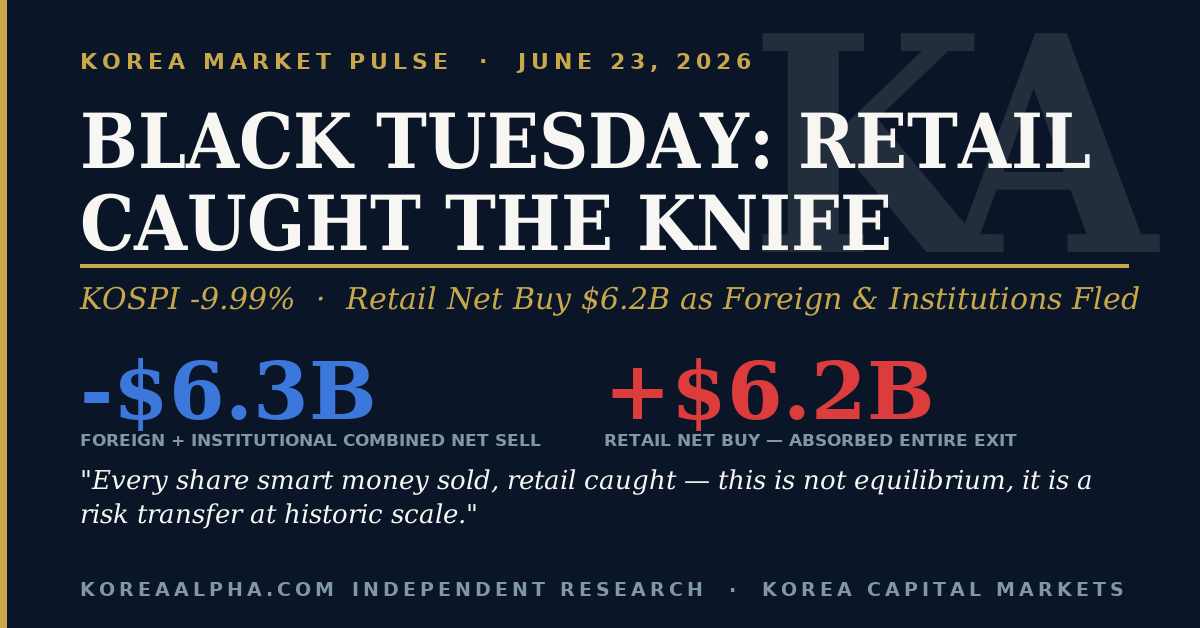
# Daily Pulse, June 23, 2026
KOSPI -9.99% | KOSDAQ -7.94% | KRW 8.59T (~$5.6B), Retail Caught Every Share Smart Money Threw
The Number That Matters
910 points. That is how far the KOSPI fell on Tuesday, the largest single-session point decline in the index's history, closing at 8,203.84. The KOSDAQ lost 7.94%. KRW 610T (~$398B) in market capitalization disappeared in six hours. The domestic press named it immediately: 검은 화요일. Black Tuesday.
The number that will define this session is not 910. It is KRW 8.59T (~$5.6B), how much retail investors bought into the collapse. While foreign and institutional money exited at scale, Korean retail absorbed every share thrown at the market. The question that follows is brutal: who was right?
Flow Structure: The Transfer of Risk
| Investor Class | Net Flow | Signal |
|---|---|---|
| Foreign (Cash) | Net Sell KRW 4.24T (~$2.8B) | Largest single-session foreign outflow of the 2026 cycle |
| Institutional | Net Sell KRW 4.48T (~$2.9B) | NPS and domestic funds exit simultaneously |
| Retail | Net Buy KRW 8.59T (~$5.6B) | Retail absorbs the entire institutional and foreign exit |
Foreign and institutional sellers combined for KRW 8.72T (~$5.7B) in net selling. Retail bought KRW 8.59T (~$5.6B). The arithmetic is almost precise: every share smart money sold, retail caught. This is not a market finding equilibrium. This is a risk transfer.
The leveraged product unwind flagged in Monday's press, levered Samsung and SK Hynix structures, accelerated that transfer as margin calls forced additional institutional selling into the retail bid. Foreign capital has already repositioned. They are not shorting Korea. They have left.
Why the Market Moved, Three Catalysts
1. SpaceX IPO, The KRW 610T (~$398B) Black Hole
The domestic headline said it plainly: "단 하루에 610조 증발했다, '자금 블랙홀' 스페이스X." SpaceX's IPO announcement triggered a global capital reallocation event. EM mandates parked in Korean equities began rotating toward the SpaceX subscription. That thesis is no longer theoretical. It is the proximate cause of Black Tuesday.
2. Leverage Unwind Cascade, Samsung and SK Hynix Levered Products
The retail-held 2x levered structures on Samsung Electronics and SK Hynix, already flagged as "실패한 삼전·닉스 레버리지", became the mechanism of amplification. As the two stocks holding the index fell, margin calls on levered positions created forced selling that drove the index further, which triggered more margin calls. The cascade is textbook. A 910-point decline is not.
3. KOSPI at 9,114, Maximum Leverage, Maximum Exposure
The domestic headline captured the timing precisely: "1만피 눈앞서 '와르르.'" The KOSPI within striking distance of 10,000 was the moment of maximum retail bullishness and maximum leveraged exposure. The closer a market approaches a round-number psychological target without crossing it, the more concentrated the long positioning becomes, and the more violent the reversal when the catalyst arrives. SpaceX was the pin. Leverage was the balloon.
The Macro Overhang
Three risks specific to this week's market structure:
1. SpaceX IPO capital reallocation is not a one-day eventEM mandates rotating toward a generational IPO do not reverse in 24 hours. The KRW 4.24T (~$2.8B) foreign exit on Tuesday reflects portfolio-level positioning decisions. Unless SpaceX subscription demand is exhausted, the rotation pressure on Korean equities continues into next week.
2. Retail's KRW 8.59T (~$5.6B) book is now the structural overhangThe largest single-session retail net buy in recent Korean market history was accumulated at prices where every institutional and foreign participant was selling. If foreign selling continues Wednesday, the retail book accumulated Tuesday is underwater before it opens, and levered portions of that book face margin exposure.
3. NPS and institutional exit velocity unresolvedTuesday's KRW 4.48T (~$2.9B) institutional net sell includes NPS flows that have been running at scale since last week's KRW 1.2T (~$793M) four-session disclosure. Whether Tuesday represents the institutional exit completing, or the mid-point of a larger reduction, determines whether 8,200 is a floor or a waystation.
Two More Factors the Domestic Press Flagged
Half-year window dressingJune 23 falls on the last trading day of the first half. Domestic fund managers facing semi-annual performance disclosure sold outperforming positions to lock in returns and dress portfolios before reporting. This mechanical selling added a layer of supply pressure with no fundamental trigger, the same stocks that had run hardest became the most attractive candidates for profit realization. The effect is calendar-driven, not macro-driven, and amplifies any existing selling pressure rather than initiating it.
Value-Up policy disappointmentThe KOSDAQ Premium League framework, expected to provide a concrete uplift mechanism for smaller-cap governance improvers, was delayed again, a six-month postponement. When details finally emerged, the structure closely mirrored Japan's governance code rather than introducing Korea-specific incentives. Investors who had positioned for a differentiated policy catalyst are now holding positions without a near-term catalyst. The delay does not change the long-run Value-Up thesis, but it removes a near-term re-rating trigger at exactly the moment the market needed one.
KoreaAlpha Take
Retail investors in Korea just made the single largest one-day bet in the market's history. KRW 8.59T (~$5.6B) absorbed in one session while every institutional and foreign player sold is not contrarian genius. It is catching a falling knife at scale, and the blade was forged by SpaceX.
The structural thesis, the SpaceX IPO capital disruption, just graduated from background risk to primary event. The KRW 610T (~$398B) market cap destruction on Tuesday is not a Korea-specific valuation correction. It is the price Korea paid for being the most liquid EM equity market available when a generational capital reallocation event arrived. Foreign and institutional money did not leave because Korea's fundamentals deteriorated overnight. They left because something better appeared, and they had the positioning, the instruments, and the exit velocity to move fast. Retail had none of those things.
The structural thesis, the foreign re-allocation question, now has its definitive answer. The June 12 KRW 2.0T (~$1.3B) foreign buying was not the beginning of a sustained re-allocation cycle. It was the last positioning reset before the exit. Twenty-four sessions of selling, one day of buying, then a KRW 4.24T (~$2.8B) single-session liquidation. The cycle is complete.
The unresolved question is not whether Tuesday was a panic capitulation or the opening act of a deeper unwind. The unresolved question is whether retail's KRW 8.59T (~$5.6B) bid holds, or whether Wednesday's open reveals it as leveraged exposure that needs to be unwound before the week is out.
One watchpoint: whether foreign net flow turns positive on Wednesday. If foreign investors return to a market they just sold at KRW 4.24T (~$2.8B) in a single session, the retail call was correct and Tuesday marks the floor. If they do not, the risk transfer of June 23 will be studied in Korean financial history as the moment retail funded the institutional exit.
Data sources: Korea Exchange, Naver Finance, Korea Economic Daily, Bloomberg Markets
[Correction, 2026-08-05] This post previously described foreign futures positioning. Our data pipeline recorded a collection failure as a zero value, so those figures, and any consecutive-session counts derived from them, were unsupported. The affected sentences have been removed.
[Correction, 2026-08-08] USD conversions in this post were computed at approximately KRW 1,380 per USD, a fallback constant our pipeline recorded when exchange-rate collection failed, not a market rate. The actual USD/KRW close on 2026-06-23 was 1,533.5. All USD figures below have been recomputed; KRW figures are unchanged.
Research only, not investment advice. KoreaAlpha does not provide personalised recommendations.