Daily Pulse: September 16, 2026
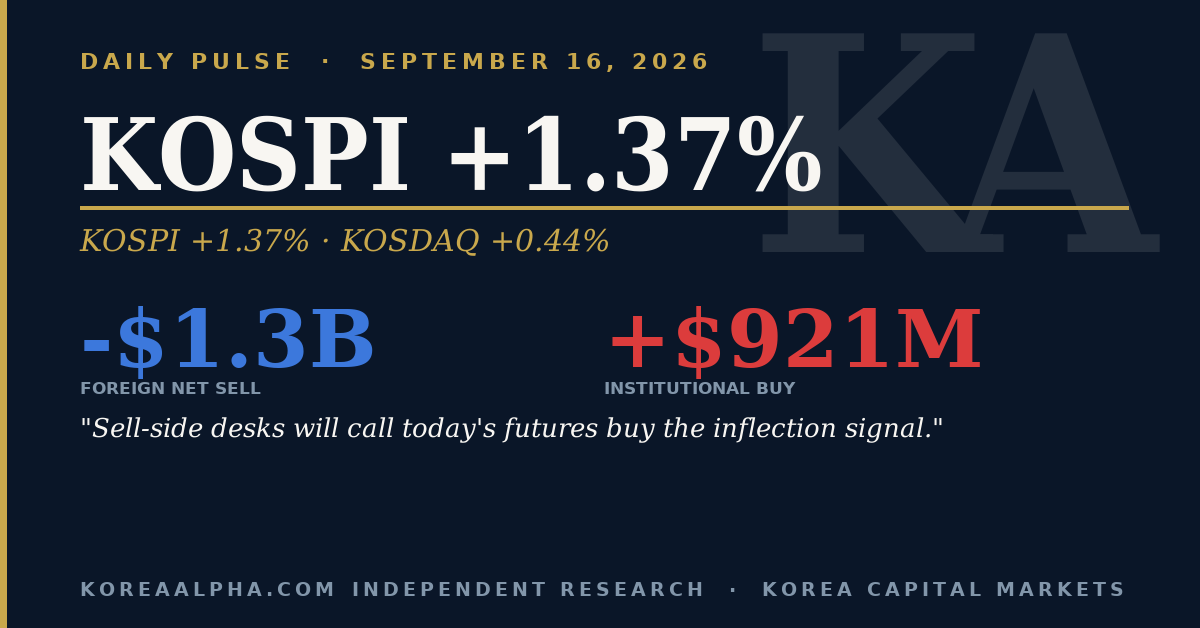
KOSPI +1.37% | KOSDAQ +0.44% | Foreign cash sold for a sixth straight session: KRW 1.71T (~$1.3B), but futures flipped to net buy
The Number That Matters
Foreign cash sold KRW 1.71T (~$1.3B) while futures bought 1,997 contracts in the opposite direction. The KOSPI opened at 6,611, hit a session high of 6,717, and closed there: the index held every point of its gain, a different intraday structure from the give-back sessions of the prior week.
Where the Money Went
Foreign net selling of KRW 1.71T (~$1.3B) concentrated in Samsung Electronics at KRW 477B (~$349M) and SK Hynix at KRW 449B (~$328M), together 54% of the foreign total, against an 83% share in the prior two sessions. Foreign buying across the top three names, Samsung Electro-Mechanics at KRW 111B (~$81M), Daehan Optical at KRW 69B (~$50M) and GS at KRW 20B (~$15M), summed to KRW 200B (~$146M), approximately 20% of the KRW 926B (~$677M) sold in the two largest foreign sell names. Institutions bought KRW 1.26T (~$921M) net; pension funds contributed KRW 172B (~$126M), financial investment KRW 802B (~$586M). Non-arbitrage program trading sold KRW 1.31T (~$960M), so the institutional gross buy exceeded net program selling within the same session. Retail sold KRW 1.20T (~$878M), with SK Hynix at KRW 1.05T (~$770M) the single largest exit.
Why the Market Moved
1. Foreign futures bought 1,997 contracts while cash sold, the same split that preceded a KOSPI recovery on September 8.
2. The two-stock semiconductor sell concentration dropped to 54% from 83% in the prior two sessions, with institutional buying absorbing KRW 418B (~$306M) in Samsung Electronics and KRW 377B (~$276M) in SK Hynix.
3. SOX rose 0.40% and VIX fell to 16.85, removing the global semiconductor headwind that accelerated selling on September 15.
The Uncomfortable Question
Samsung Electro-Mechanics drew foreign and institutional buying simultaneously while retail sold KRW 210B (~$154M) of it. That is the only conviction overlap in today's data. Foreign cash selling extended to a sixth session; the two-stock concentration fell from 83% to 54%, but total foreign outflow of KRW 1.71T (~$1.3B) remained large. Whether the lower concentration marks a structural shift in what foreigners are exiting, or simply reflects one session of wider distribution, is not answerable from a single day.
Key Disclosures Today
Celltrion filed both a treasury share cancellation decision and a buyback completion report on DART; no KRW amount was disclosed in the filing summaries.
KoreaAlpha Take
Sell-side desks will call today's futures buy the inflection signal. Foreign cash sold KRW 1.71T (~$1.3B), the sixth consecutive session of net selling, and the futures buy of 1,997 contracts does not change that. The concentration drop from 83% to 54% in Samsung Electronics and SK Hynix selling is the more meaningful data point: it breaks the structural pattern that has defined every session since September 11. The unresolved question is whether tomorrow's session restores the 83% concentration or confirms that the two-stock exit is broadening into something different. The trade is simple: watch whether the Samsung Electronics and SK Hynix combined share of foreign cash selling returns above 70% in the next session.
Data sources: Korea Exchange, DART, Bloomberg
Research only. Not investment advice. KoreaAlpha does not provide personalised recommendations.
Flow figures are KRX investor-type trading value across all listed boards (KOSPI, KOSDAQ, KONEX), common stock only, excluding ETF, ETN and ELW; institutions = the KRX institutional total investor type. Foreign, institutional and retail do not sum to zero: the balance, KRW 1.65 trillion (~$1.2B) net bought on this session, sits with other corporations and other foreign investors, categories this report does not collect.