Daily Pulse: July 10, 2026
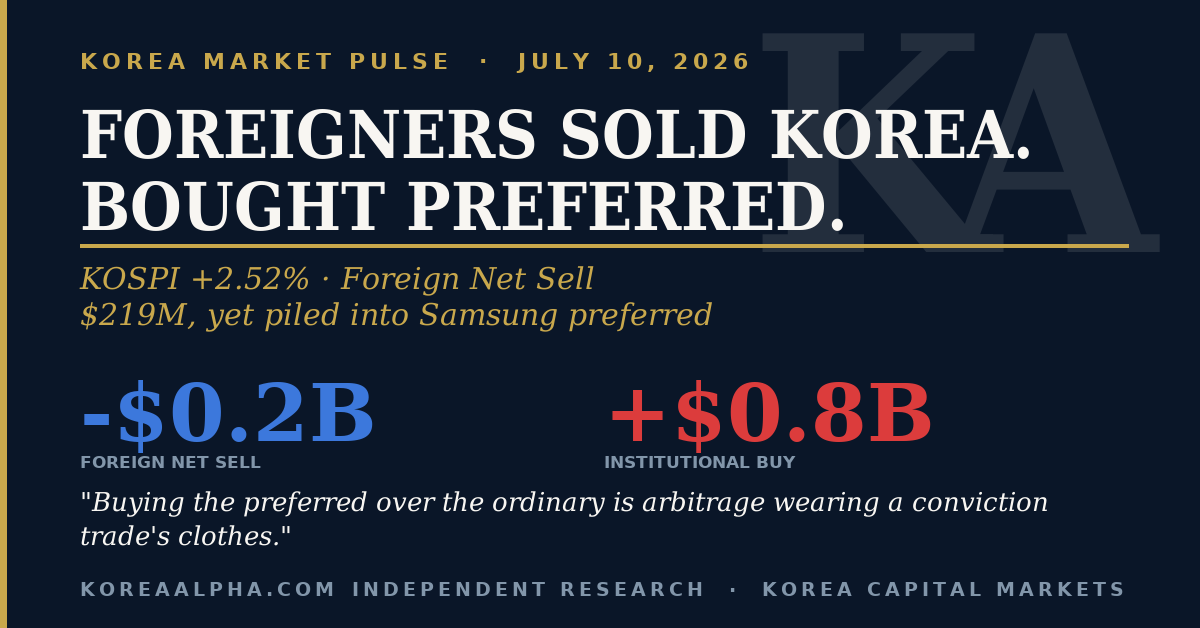
KOSPI +2.52% | KOSDAQ +5.47% | Foreign net sell KRW 330B (~$219M), top three foreign purchases: Samsung Electronics, Samsung Electro-Mechanics, Samsung Electronics preferred shares
The Number That Matters
KRW 1.13T (~$751M). That is what institutions deployed into a falling-foreign session to lift the KOSPI 2.52%. Foreign investors net sold KRW 330B (~$219M) in aggregate, yet their top three individual purchases were Samsung Electronics, Samsung Electro-Mechanics, and Samsung Electronics preferred shares. The aggregate number hides a rotation; the stock-level detail reveals it.
Where the Money Actually Went
Foreign net selling of KRW 330B (~$219M) masked a concentrated bet: Samsung Electronics (+KRW 193.6B, ~$129M), Samsung Electro-Mechanics (+KRW 150.3B, ~$100M), Samsung Electronics preferred shares (+KRW 110.2B, ~$73M), SK Square (+KRW 108.6B, ~$72M), and Hyundai Motor (+KRW 62.9B, ~$42M). Institutions added KRW 1.13T (~$751M) to support the index. Retail sold KRW 770B (~$512M).
Why the Market Moved
1. SK Hynix priced its US listing at $149 per share, raising $26.5B in the largest-ever foreign debut on a US exchange, repatriation sentiment moved Korean equities at the open.
2. Institutions absorbed the session with KRW 1.13T (~$751M) in net buying, preventing a repeat of last week's cascade.
3. KOSDAQ surged 5.47% as small-cap names caught a bid alongside the broader repatriation flow.
The Uncomfortable Question
Foreign investors chose Samsung Electronics preferred shares over the ordinary, on the same day they net sold the market. Preferred shares carry no voting rights and trade at a structural discount to ordinary; buying them over the common is a yield and discount-capture trade, not a conviction re-entry.
Key Disclosures Today
Samsung Electronics filed a treasury share disposal result report, filed on a session where foreign buyers accumulated both ordinary and preferred shares simultaneously.
KoreaAlpha Take
Buying the preferred over the ordinary is not a re-entry signal, it is an arbitrage trade wearing one's clothes.
Foreign investors put Samsung Electronics ordinary, Samsung Electro-Mechanics, and Samsung preferred in their top three on the day SK Hynix debuted in New York. The aggregate says they net sold. The stock list says they selectively accumulated.
The question is whether the preferred share purchase marks the start of a systematic repatriation cycle, or whether it is the last trade of an investor class that has already decided to own Korea through a New York-listed vehicle instead.
The trade is simple: watch whether foreign futures register a net long position before Samsung Electro-Mechanics earnings land next week.
Data sources: Korea Exchange, DART (금융감독원 전자공시시스템), Bloomberg Markets, Naver Finance
[Correction, 2026-08-05] This post previously described foreign futures positioning. Our data pipeline recorded a collection failure as a zero value, so those figures, and any consecutive-session counts derived from them, were unsupported. The affected sentences have been removed.
Research only, not investment advice. KoreaAlpha does not provide personalised recommendations.