Daily Pulse: July 9, 2026
Foreign capital bought Samsung Electronics (+$160M) harder than the entire KOSPI (+$131M net), with institutions confirming (+$776M). But foreign futures still sit at zero.
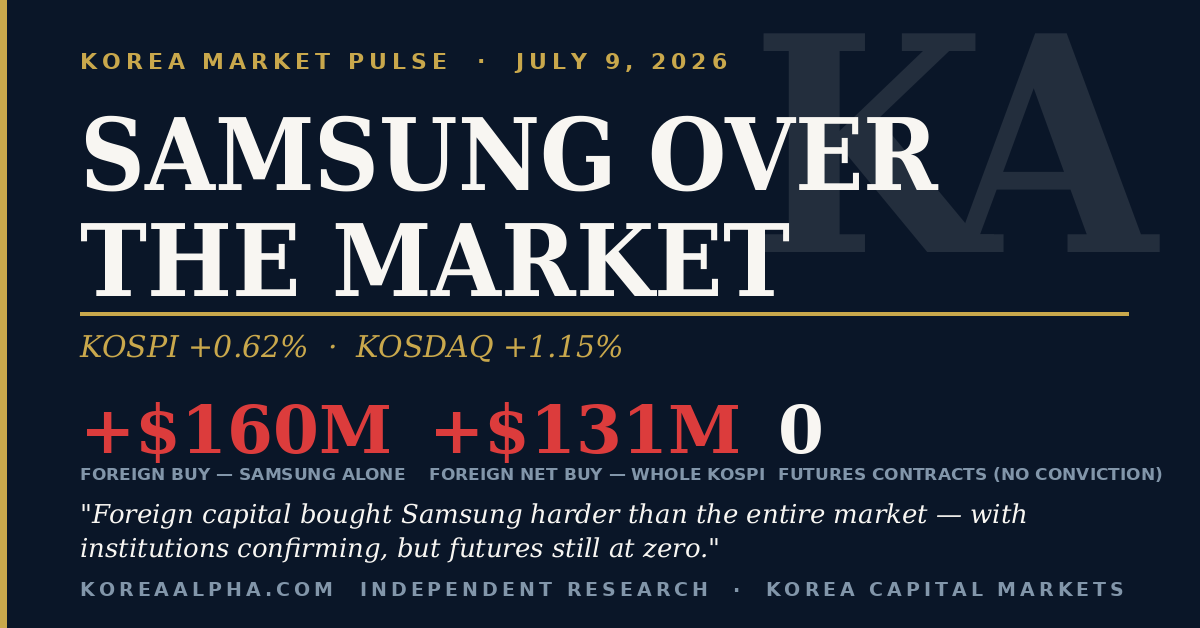
KOSPI +0.62% | KOSDAQ +1.15% | Foreign capital bought Samsung Electronics harder than it bought the whole market, two days after the earnings miss
The Number That Matters
KRW 241.4B (~$160M). That is what foreign investors net bought in Samsung Electronics alone today, more than their entire net cash-equity purchase of KRW 197.6B (~$131M) across the whole KOSPI. In other words, foreigners bought Samsung so hard they were net sellers of everything else combined. Two days after an earnings miss sent the stock down 6%, the index heavyweight became the single largest foreign buy.
Where the Money Actually Went
The basket widened. Behind Samsung Electronics came Samsung Electro-Mechanics (+KRW 190.7B, ~$126M), SK Square (+KRW 146.9B, ~$97M), LG Innotek (+KRW 91.7B, ~$61M), and Samsung SDI (+KRW 45.3B, ~$30M), the index name plus its substrate, component, and holding-company ecosystem in one session. And for the first time this cycle, institutions bought alongside: KRW 1.17T (~$776M) net, absorbing retail's KRW 1.27T (~$839M) exit. Two buyer classes, same direction, on the same names.
Why the Market Moved
- Samsung Electronics post-earnings dip buying, foreigners accumulated the index heavyweight two sessions after the -6% earnings-miss selloff.
- SK Hynix's US offering came in more than seven times oversubscribed, repricing the repatriation and AI-memory thesis across the whole Korean semiconductor chain.
- Institutions turned net buyers (KRW 1.17T / ~$776M), providing a second confirming bid and absorbing heavy retail selling.
The Uncomfortable Question
For two weeks the foreign buy list skipped Samsung Electronics entirely. Today it led. Institutions confirmed the same direction with three-quarters of a billion dollars. On paper, this is the broad, two-sided return that a real bottom requires. Sustained re-allocation usually shows up in futures first. It still hasn't. So is this the turn, or the largest single-session dip trade of the cycle, cash-only and reversible?
Key Disclosures Today
NHN filed a merger resolution (DART: 20260708000501), and multiple treasury-share programs continued across mid-caps. Nothing that alters the index-level flow story, but the buyback cadence remains consistent with the mandatory-cancellation regime we covered in Disclosure Decoder #001.
KoreaAlpha Take
Foreign capital buying Samsung Electronics harder than the entire market, with institutions confirming, is the strongest signal of a turn this cycle has produced. The missing piece is the one that usually comes first.
A real re-allocation is broad, two-sided, and positioned in derivatives before the cash prints. Today delivered the first two: the buy basket widened from the periphery into the index heavyweight, and institutions bought three-quarters of a billion dollars in the same names. Cash says accumulate; derivatives say wait. When those two disagree this sharply, the futures desk is usually the one telling the truth about conviction, and the tell will be whether foreign futures finally move net long before this bounce fades.
Research only, not investment advice. KoreaAlpha does not provide personalised recommendations.
[Correction, 2026-08-05] This post previously described foreign futures positioning. Our data pipeline recorded a collection failure as a zero value, so those figures, and any consecutive-session counts derived from them, were unsupported. The affected sentences have been removed.