Policy Decoder #002: Korea Named $1 Trillion. It Did Not Name the Date.
Korea's mega-project briefing names KRW 800T for new southwestern fabs, KRW 81T for HBM packaging, KRW 550T for 8.4GW AI data centers. The only dated commitment — five-year capacity doubling — belongs to existing Yongin. What that asymmetry tells you.
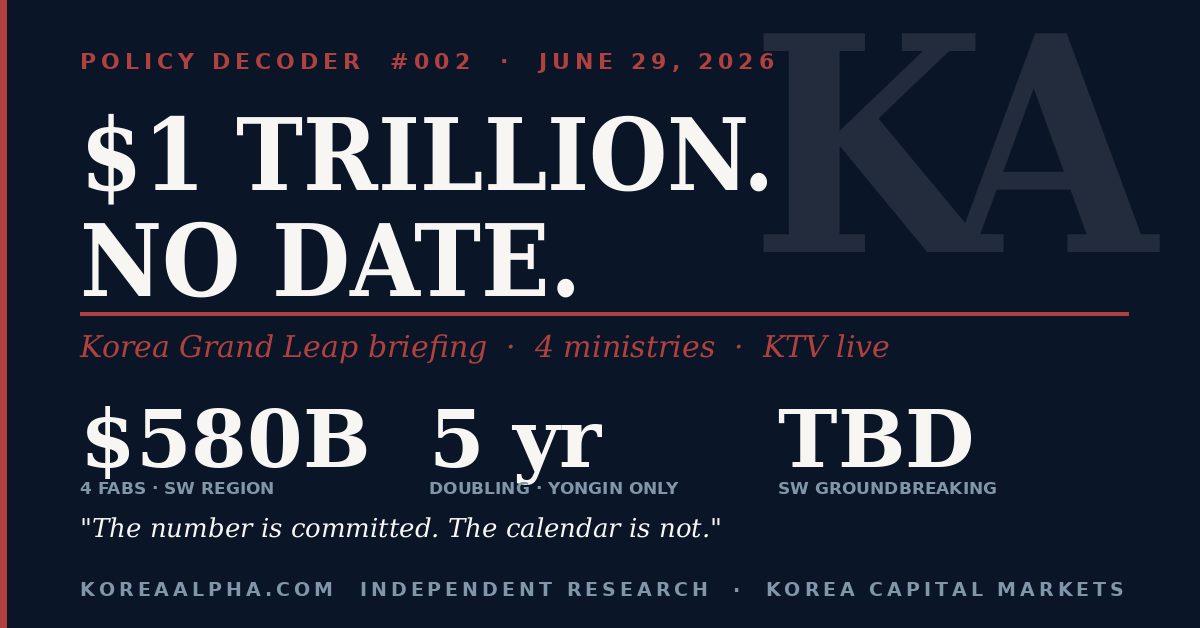
KoreaAlpha Policy Decoder, Issue #002 · June 29, 2026
THE SIGNAL
Policy / event:Korea Grand Leap, 3 Mega Projects National Briefing
Source body:Joint briefing by the Ministry of Trade, Industry and Energy; the Ministry of Science, ICT and Future Planning; the Ministry of Climate, Energy and Environment; and the Ministry of Land, Infrastructure and Transport
Date broadcast:29 June 2026, 14:00 to 15:20 KST · Cheong Wa Dae Yeongbingwan · KTV live
Official link:motir.go.kr
WHAT WAS ANNOUNCED
FACT, source-traceable only
The government unveiled three named investment tracks.KRW 800T (~$519B) is committed to four new memory fabs and a supplier-and-talent ecosystem in the southwestern region, with site selection, permitting, and groundbreaking framed as a public-private undertaking still to be assembled.KRW 81T (~$53B) is committed to an HBM packaging cluster in Chungcheong, new HBM fabs in Onyang and Cheonan, packaging investment in Cheongju, with execution described as "timely." ApproximatelyKRW 550T (~$357B) is committed by SK, GS, and Naver for an 8.4GW first-phase AI data-center build (SK 5GW, GS 2.4GW, Naver 1GW), with SK's segment scaling to 15GW by 2035 for a total of 18.4GW. Separately, the Yongin national and general industrial complexes are to have their final-fab completion timelines compressed byseven and twelve years respectively, doubling Korea's memory production capacity withinfive years.KRW 30T+ over fifteen years is committed to next-generation, edge, and defense-semiconductor R&D.
WHAT IT ACTUALLY SIGNALS
KoreaAlpha VIEW
The announcement reads as a national capacity doubling tied to two physically separate tracks, and the operative detail is that they are being treated very differently. The five-year doubling target lives on the Yongin track, where land, permits, and partners are already in motion; the southwestern KRW 800T track is described in terms of scale and intent, with the entire upstream sequence framed as work still to be done. This suggests Korea is signaling ambition and money for the new cluster but reserving its dated commitments for the cluster it can already deliver on. The same asymmetry holds for the HBM packaging investment in Chungcheong and for the first phase of the data-center build, both of which receive a money figure without a near-term schedule attached.
To continue: the money mechanism for foreign positioning, the single most revealing detail in the briefing, the conviction read on follow-through, and the specific next event that will confirm or falsify it, all in the Premium section.


