Daily Pulse: September 7, 2026
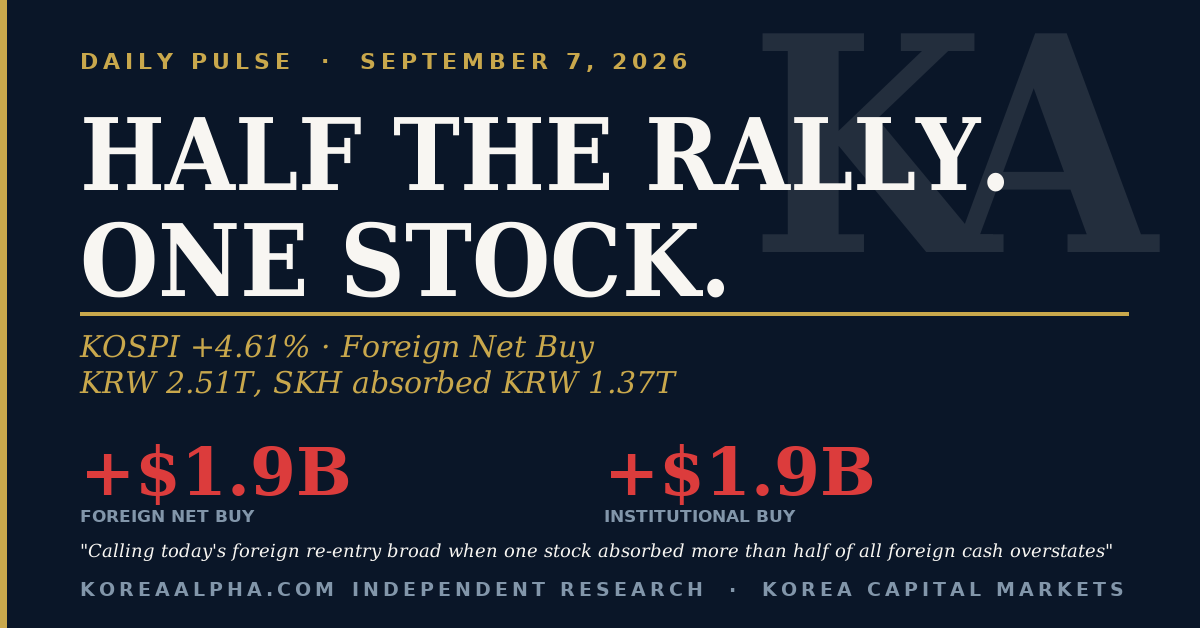
KOSPI +4.61% | KOSDAQ +1.07% | Foreign cash plus futures both net bought for a second consecutive session: KRW 2.51T (~$1.9B) cash, 10,967 contracts
The Number That Matters
SK Hynix absorbed KRW 1.37T (~$1.0B) of foreign cash buying and KRW 644B (~$479M) of institutional buying in the same session. More than half of all foreign cash purchases on a KOSPI +4.61% day ran through a single stock. The breadth question is whether that concentration is a feature or a warning.
Where the Money Went
Foreign cash buying of KRW 2.51T (~$1.9B) concentrated in SK Hynix at KRW 1.37T (~$1.0B), Samsung Electronics at KRW 882B (~$656M), Samsung Electro-Mechanics at KRW 148B (~$110M), and SK Square at KRW 138B (~$103M). Foreign cash and futures moved in the same direction. The institutional total of KRW 2.52T (~$1.9B) was dominated by the financial investment sub-category at KRW 2.12T (~$1.6B), which includes program trading and trust-based buybacks not disaggregated in this data; pension funds contributed KRW 5B (~$4M), effectively neutral. Three names appeared on both the foreign and institutional buy lists: Samsung Electronics, SK Hynix, and SK Square. Retail sold KRW 6.65T (~$4.9B) net, distributing SK Hynix at KRW 3.11T (~$2.3B) and Samsung Electronics at KRW 2.58T (~$1.9B). The SOX print behind the move, 11,735 (+3.38%), was Friday's close. US markets were shut on Monday, so Asia traded ahead of the next US session rather than after one.
Why the Market Moved
1. Semiconductor sentiment carried over from Friday, when SOX closed at 11,735 (+3.38%). US markets were shut on Monday, so no new US session set the tone.
2. Foreign cash and futures both moved in the same direction, extending Thursday's reversal into a second session and providing structural index support.
3. The move was narrow by index as well as by stock: the KOSDAQ added 1.07% against the KOSPI's 4.61%, a gap of more than four times on a session led by two large caps.
The Uncomfortable Question
Retail sold KRW 5.69T (~$4.2B) in SK Hynix and Samsung Electronics combined, while foreign and institutional buyers absorbed both names simultaneously. Pension funds added KRW 5B (~$4M), essentially zero. The institutional buy total rests almost entirely on the financial investment sub-category at KRW 2.12T (~$1.6B), a figure that cannot be separated from program trading and trust-based buybacks in this data. Whether the conviction behind today's two-leg foreign move extends beyond a single OpenAI headline is the question the data cannot settle.
Key Disclosures Today
No material DART filing warrants separate treatment today.
KoreaAlpha Take
Two sessions of foreign cash and futures buying in the same direction is the strongest structural signal since the September 2 liquidation. The sell-side will call this a confirmed re-entry. The data says something narrower: more than half of all foreign cash buying went into one stock, pension funds sat out at near-zero, and the institutional print is driven by a category that bundles program trading with discretionary allocation in a way this report cannot untangle. The foreign re-entry into Korean equities may be real, but calling it broad when SK Hynix alone absorbed KRW 1.37T (~$1.0B) of a KRW 2.51T (~$1.9B) session overstates what is visible. The trade is simple: watch whether foreign futures net trade holds positive on the next session without an AI catalyst.
Data sources: Korea Exchange, DART, Naver Finance, Bloomberg
Research only. Not investment advice. KoreaAlpha does not provide personalised recommendations. Corrected 2026-09-08: an earlier version stated a daily move for USD/KRW; the rate we record is not a closing rate, so that sentence has been removed.
Flow figures are KRX investor-type trading value across all listed boards (KOSPI, KOSDAQ, KONEX), common stock only, excluding ETF, ETN and ELW; institutions = the KRX institutional total investor type.


