The $1 Trillion Korea Announced: The One Number That Decides If It's Real
Korea named more than KRW 1,400 trillion (~$1 trillion) across three mega-projects. The amounts are the least informative part. What is dated, and what is not, is the tell.
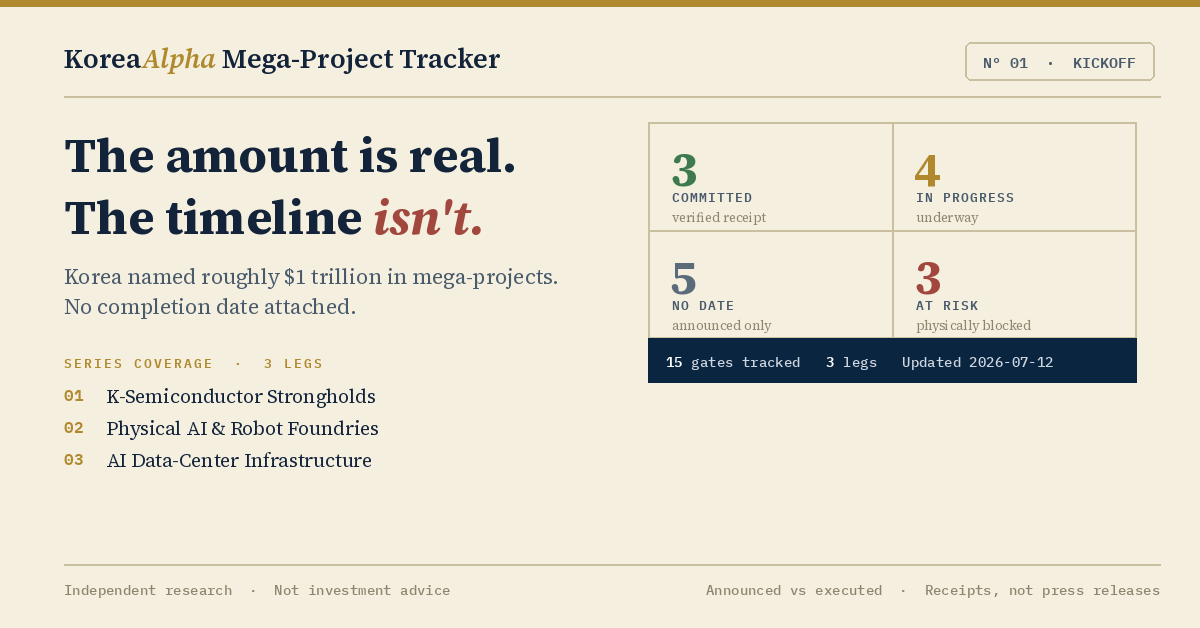
Mega-Project Watch · Kickoff · A KoreaAlpha free flagship
KoreaAlpha Research · July 2026
Executive Summary
On June 29, 2026, Korea did something it rarely does with this much money at stake. It put a single, staggering figure on the table. Across three "national leap" mega-projects (semiconductors, AI robotics and physical AI, and AI data centers), the government and its private partners named more than KRW 1,400 trillion (~$930 billion) in headline commitments. The composition is public and specific: KRW 800 trillion (~$519 billion) for four new fabs in the southwest, KRW 550 trillion (~$357 billion) for AI data centers led by SK, GS, and Naver, and KRW 81 trillion (~$53 billion) for advanced packaging and HBM in Chungcheong.
(FACT) The amounts are real, sourced, and unusually concrete.
(KoreaAlpha VIEW) The amounts are also the least informative part of the announcement. In Korean industrial policy, the headline number is the easy commitment; the schedule is the hard one. And the schedule is exactly where this package is uneven: dated and shortened where a track already existed, and conspicuously undated where the money is newest and largest. That gap is the single variable that will decide whether "$1 trillion" becomes capex or stays a press release. It is also the lens for everything KoreaAlpha will publish on this story from here. We track announced versus executed, not announced versus announced.
This is the kickoff of Mega-Project Watch. It is free, because we want every foreign desk trading Korea to start from the same scorecard.
The Context: Why Now, and Why Foreigners Should Care
(FACT) Foreign ownership of the KOSPI sits near a six-year high, and Korea has been the top single-country emerging-market ETF destination this year. The mega-projects arrive as the global AI build-out turns semiconductors, power, and data-center capacity into the scarcest resources in the market.
(KoreaAlpha VIEW) For a global PM, this is not a Korea story. It is a supply-chain story that happens to be denominated in won. The three legs map onto the three chokepoints of the AI era: the chips (memory and HBM), the machines that will build and move things (physical AI), and the power-hungry compute to run it all (data centers). Korea is trying to plant a flag in each. The reason to care is not patriotism or sentiment. It is that a credibly executed KRW 1,400 trillion (~$930 billion) program re-rates a cluster of names that global capital already owns, while a slipping one quietly transfers that capex, and the multiple, somewhere else. The difference between those two outcomes is not in the amount. It is in the calendar.
The Analysis: Three Legs, One Question
Leg 1: Semiconductors, dated where it existed and undated where it's new
(FACT) Two things were announced together. First, the existing Yongin cluster had its final-fab completion timelines shortened by 7 years (national complex) and 12 years (general complex), with a stated goal of doubling memory production capacity within five years. Second, an entirely new southwest cluster of four fabs worth KRW 800 trillion (~$519 billion) was unveiled, to be advanced through a government-local-private permitting fast-track. Chungcheong adds KRW 81 trillion (~$53 billion) for HBM and packaging.
(KoreaAlpha VIEW) Read the two halves side by side and the tell is already visible. Yongin, a project with land, tenants, and years of prior filings, got specific acceleration: real numbers, real deadlines. The southwest KRW 800 trillion (~$519 billion), the newest and by far the largest line, got an amount and a fast-track promise, but no completion date. Domestic coverage flagged the same thing in plainer terms: southwest infrastructure remains a question mark. A fast-track is a mechanism, not a milestone. The KoreaAlpha reading is that the semiconductor leg is two projects wearing one headline: one you can already put on a timeline, and one you cannot yet.
Leg 2: AI Robotics & Physical AI, the seed round of the three
(FACT) The plan commits to deploying more than 1,000 industrial AI robots per year, training 10,000 physical-AI specialists over five years, building a robot foundry and component cluster in Saemangeum, and developing an independent physical-AI foundation model within three years.
(KoreaAlpha VIEW) This is the smallest leg by capital and the most speculative by outcome, effectively Korea's venture bet inside a national program. The "1,000 robots a year" and "10,000 specialists" are inputs the government directly controls, which makes them credible but modest. The "independent foundation model in three years" is the ambition that matters and the one least under anyone's control. For a foreign investor, this leg is optionality, not a base case: cheap to announce, hard to verify, and the first place to look when you want to know whether the program is funding capability or headlines. Watch the Saemangeum groundbreaking and the anchor private investor, not the specialist-training press releases.
Leg 3: AI Data Centers, capacity announced far beyond capacity committed
(FACT) The target is 18.4GW of AI data-center capacity in total, led by SK, GS, and Naver with roughly KRW 550 trillion (~$357 billion) of investment. But the first-phase commitment is 8.4GW, under half the headline. Supporting measures include a dedicated data-center power tariff, disclosure of grid-spare substation capacity to steer siting, and linkage to a renewable-energy target of roughly 100GW by 2030.
(KoreaAlpha VIEW) Here the gap between announced and committed is quantified for you: 18.4GW is the ambition, 8.4GW is the money on the table today. That is not a criticism (staged capacity is normal), but it is precisely the kind of distinction that gets lost when the headline travels. The binding constraint on this leg is not capital; it is power and grid. A data center without a firm interconnection date is a spreadsheet. The renewable-100GW-by-2030 target and the substation-disclosure mechanism are the real dependencies, and they carry their own execution risk. The KoreaAlpha reading is to value this leg on committed gigawatts with a power contract, not announced gigawatts.
The KoreaAlpha Mega-Project Execution Tracker
Because the whole story turns on execution, we are scoring it the way we score Value-Up: on follow-through, not announcements. Each leg moves through three states:
- Announced: a number exists (all three legs are here today).
- Committed: money, land, or a signed partner is attached (data-center Phase 1; Yongin).
- Executed: a groundbreaking, a power contract, a permit issued, or private capital drawn down (the state almost nothing is in yet).
The tracker follows the observable receipts that move a leg rightward: southwest fab groundbreaking dates, Saemangeum's anchor investor, data-center interconnection agreements, the renewable-100GW build rate, and the second-half economic strategy's tax and fiscal measures for regional workers. The free view will show the headline states; the premium view will show the deltas, the dates, and the tell each month.
Investment Implications
(KoreaAlpha VIEW, not a recommendation) The names exposed to this program are already the ones global capital holds: memory and HBM leaders, the data-center consortium members, the robotics and auto-adjacent physical-AI players, and, less obviously, the power, grid, and materials-equipment suppliers that every leg quietly depends on. The framing that matters for an allocator is this: Korea's mega-project is becoming an allocation call, not a stock pick. If the program executes on schedule, it is a multi-year domestic capex supercycle with a policy floor under it. If it slips, the capex and the re-rating migrate to whichever jurisdiction breaks ground first. The position you take is really a view on the calendar, and the calendar is what we will track.
Risks & Scenarios
(FACT/VIEW) The credible risks are specific, not vague. On power, the renewable-100GW-by-2030 target is itself an ambitious program the data centers now depend on. On permitting and land, the southwest fast-track has no completion date attached yet, and domestic coverage has already questioned the region's infrastructure readiness. On private draw-down, announced private capital converts on a company's own timeline, not the government's. On political and budget timing, regional tax incentives and fiscal support are slated for the second-half economic strategy (real, but not yet law). The bear case is not that the money is fake. It is that capacity announced runs ahead of capacity committed, and committed runs ahead of executed, and the market prices the first number while the third is what pays.
The KoreaAlpha View: the tell, and what to watch
The single most revealing detail in the entire package is the asymmetry of dates. Where a track already existed (Yongin), Korea shortened the timeline by specific years. Where the money is newest and largest (the southwest KRW 800 trillion, ~$575 billion), it named the amount and omitted the date. And where the ambition is boldest (18.4GW of data-center capacity), it committed to less than half. Amounts are the announcement; dates and gigawatts-under-contract are the intent. What is dated, and what is not, is the tell.
That is the lens for this entire series. We will not re-report the headline number. We will track the receipts (groundbreakings, power contracts, permits, draw-downs), and each month we will tell you which leg moved from announced to committed to executed, and which one quietly did not.
Watch next:
- A completion or groundbreaking date for the southwest fabs (the missing calendar).
- Saemangeum's anchor private investor and a foundry groundbreaking.
- The first data-center interconnection agreement inside the 8.4GW committed phase.
- The second-half economic strategy: whether regional tax and fiscal measures become concrete.
Mega-Project Watch continues in Policy Decoder, with the full Execution Tracker for Premium subscribers. This kickoff is free. Share it with the desk that still thinks the story is the amount.
Research only, not investment advice. KoreaAlpha does not provide personalised recommendations.
[Correction, 2026-08-08] USD conversions for the mega-project figures in this post were computed at an incorrect exchange rate. They have been recomputed at KRW 1,541.5 per USD, the rate on 29 June 2026, the date of the announcement. KRW figures are unchanged. All KoreaAlpha mega-project coverage now uses this single reference rate, so the same KRW figure no longer appears as two different USD values across the series.


