Daily Pulse: August 31, 2026
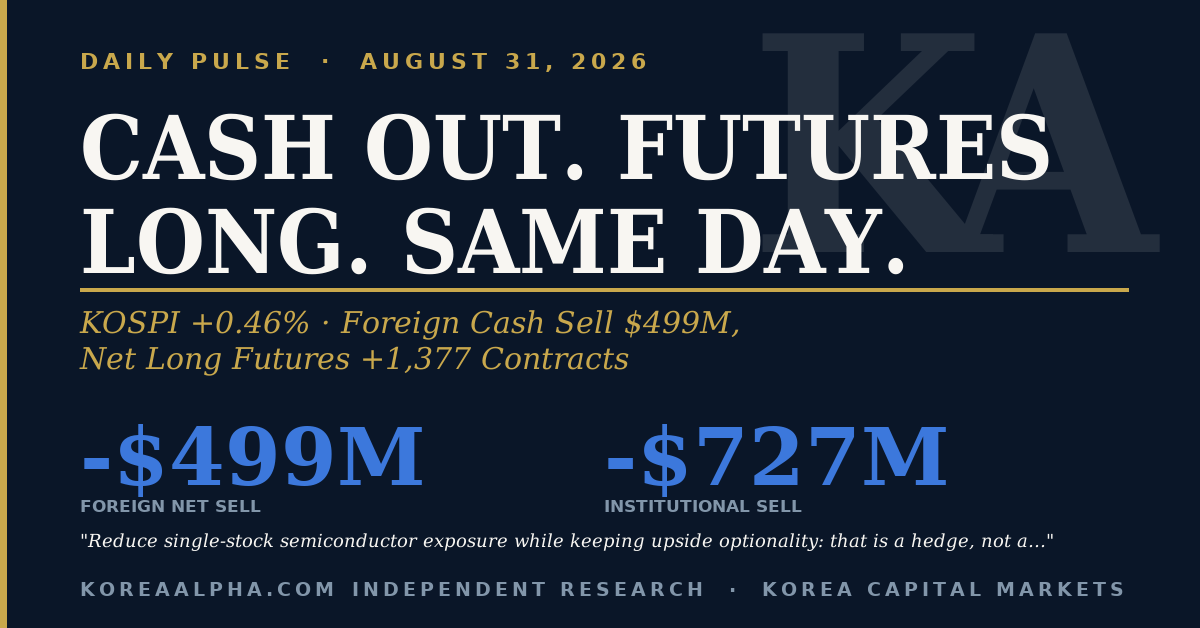
KOSPI +0.46% | KOSDAQ -0.49% | Foreign futures +1,377 contracts while cash net sold KRW 683B (~$499M)
The Number That Matters
Foreign investors sold KRW 338.2B (~$247M) of SK Hynix in cash while simultaneously placing 1,377 net long futures contracts on the index. The two positions point in opposite directions. Cash selling is distribution; futures buying is a directional bet on the index rising. Both happened on the same day, from the same investor type.
Where the Money Went
Foreign cash net selling of KRW 683B (~$499M) concentrated in SK Hynix at KRW 338.2B (~$247M), Samsung SDI at KRW 71.6B (~$52M), and Doosan Enerbility at KRW 65.6B (~$48M). The foreign buy side went to Hyundai Motor KRW 56.3B (~$41M), LG Electronics KRW 53.8B (~$39M), and LG Innotek KRW 50.1B (~$37M). Institutions sold KRW 995B (~$727M) net, with Samsung Electronics taking KRW 594.5B (~$434M) of institutional selling and SK Hynix a further KRW 507.2B (~$370M). Against that selling, institutions bought Samsung Electro-Mechanics KRW 73.6B (~$54M), SK Innovation KRW 36.6B (~$27M), and LG Electronics KRW 25.8B (~$19M). Samsung Electro-Mechanics and LG Electronics drew simultaneous foreign and institutional buying, with retail as the sole seller in both. Retail bought KRW 96B (~$70M) net overall.
Why the Market Moved
1. Foreign and institutional simultaneous selling in Samsung Electronics and SK Hynix kept the KOSPI advance to +0.46% despite foreign futures buying providing index support.
2. USD/KRW fell to 1,369.7, a 13-month low, as dollar selling concentrated in the currency market; foreign equity flows did not follow the stronger won.
3. Construction stocks outperformed for August on nuclear and AI data centre demand expectations, providing a secondary lift to the index separate from semiconductor flows.
The Uncomfortable Question
USD/KRW at 1,369.7 is the weakest dollar level against the won in 13 months. The textbook assumption is that won strength attracts foreign equity inflows. Today foreign investors sold KRW 683B (~$499M) of Korean equities. The question is whether the won is strengthening because of capital inflows that are bypassing equities entirely, or whether foreign investors are hedging currency exposure through futures rather than expressing it through cash stock purchases.
Key Disclosures Today
Celltrion filed a share buyback decision on DART; Samsung Biologics filed a subsidiary acquisition decision on DART.
KoreaAlpha Take
Foreign investors sold cash equities and bought index futures on the same session. That is not a re-allocation. It is a hedge: reduce single-stock semiconductor exposure while maintaining upside optionality on the index. Samsung Electro-Mechanics has now drawn simultaneous foreign and institutional buying for three consecutive sessions, with retail distributing each time. Whether that constitutes a durable rotation into components or a pre-positioning basket ahead of semiconductor re-entry remains the unresolved question. The trade is simple: watch whether foreign cash selling of SK Hynix continues on a session where futures remain net long.
Data sources: Korea Exchange, DART, Naver Finance
Research only. Not investment advice. KoreaAlpha does not provide personalised recommendations.
Flow figures are KRX investor-type trading value across all listed boards (KOSPI, KOSDAQ, KONEX), common stock only, excluding ETF, ETN and ELW; institutions = the KRX institutional total investor type.


