Alpha Signals #001: Foreign Capital Bought Korea Today. It Just Wasn't the KOSPI.
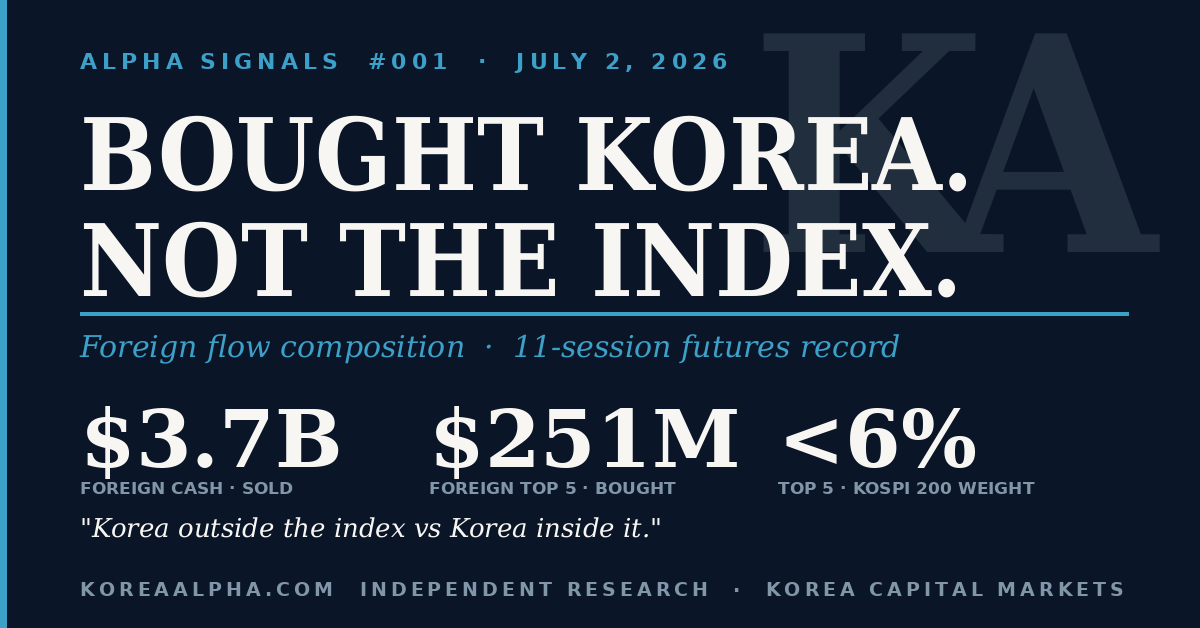
Foreign capital net-sold KRW 5.13T from the KOSPI on July 2. But the top five foreign purchases add up to KRW 348.1B. Their combined KOSPI 200 weight is under 6 percent. What that composition tells you about the index.
[Editor's Note, 2026-08-16] This piece rests in part on foreign futures positioning, specifically a run of consecutive sessions at zero net long contracts. Those figures were not observations. Our collection process recorded a failed fetch as a zero value, so the futures readings, the session counts derived from them, and the conviction rating that rested on them are unsupported. The cash-equity flow analysis in this piece, what foreign capital bought and did not buy, is unaffected and stands. We are leaving the original text in place rather than rewriting it, so readers can see what was claimed and what it was based on.
KoreaAlpha Alpha Signals, Issue #001 · 2 July 2026
THE SIGNAL
Event: KOSPI collapse session, 2 July 2026, the second single-session decline of more than five percent in eleven trading days.
Data window: Single trading session flow tallies, plus the eleven-session running foreign futures record through 2 July.
Series debut: Alpha Signals #001, event-driven conviction reads on Korean market structure for foreign portfolios.
THE SETUP
FACT, source-traceable only
On a session where the KOSPI closed at 7,648.09 (down 7.89 percent), foreign capital net-sold KRW 5.13T (~$3.3B) on the cash tape. Institutional investors added another KRW 0.48T (~$0.3B) of net selling. Retail net-bought KRW 5.40T (~$3.5B), absorbing 105 percent of the foreign exit and 96 percent of the combined foreign-plus-institutional exit.
The five largest foreign cash purchases on this same session: (1) Samsung Electronics preferred +KRW 111.0B (~$72.0M); (2) Hyundai Motor +KRW 72.5B (~$47.0M); (3) DB HiTek +KRW 70.6B (~$45.8M); (4) LG Electronics +KRW 52.2B (~$33.8M); (5) Samsung C&T +KRW 41.8B (~$27.1M). Samsung Electronics ordinary shares did not appear on the buy list. SK Hynix, down 14.57 percent on the session, did not appear. Together the two absent names carry roughly 35 percent of KOSPI 200 index weight.
Foreign futures net position: zero long contracts, for the eleventh consecutive session. This record spans both index-level shock sessions (23 June and 2 July) and the Samsung, Corning glass substrate joint venture disclosure filed on 1 July.
THE ASYMMETRY
KoreaAlpha VIEW
Foreign capital did not step away from Korea today. It reallocated within Korea while selling the KOSPI benchmark. Each name on the buy list expresses a specific structural preference. Samsung preferred over ordinary is a discount vehicle on the same underlying equity, foreign capital took the discount when the index-heavy version was available at the same session's compressed pricing. DB HiTek is legacy analog and specialty foundry, direct semiconductor exposure without HBM-cycle sensitivity. Hyundai Motor and LG Electronics express industrial and consumer capex exposure that clears the AI capex concern entirely. Samsung C&T is the holding company at the center of Samsung governance rather than the operating semiconductor entity.
The composition is coherent. It is not a stopgap or a cover trade. It is what a portfolio looks like when the manager wants Korean equity exposure but does not want to underwrite the current KOSPI index composition. The eleven-session futures zero confirms this is not tactical positioning, an incoming long would show up in the derivatives book first, and it has not, across two shock sessions and a governance-relevant joint venture disclosure.
To continue: the bull and bear cases, THE TELL, the conviction read on how long the pattern persists, and the specific triggers that would confirm or falsify it, all in the Premium section.


